
Feature Engineering with AI: Smarter Data, Better Models
In modern data science, raw data alone is not enough.
Instead, meaningful features determine model success.
For this reason, feature engineering with AI plays a vital role.
However, traditional feature engineering takes time.
Moreover, manual processes often introduce bias.
As a result, many teams struggle with efficiency.
Thankfully, Feature Engineering with AI is transforming this process.
Today, artificial intelligence automates complex feature creation.
Consequently, machine learning models become faster and smarter.
In this guide, AI-driven feature engineering is explained clearly.
Additionally, benefits, techniques, tools, and best practices are covered.
By the end, the importance of AI will be obvious.
What Is Feature Engineering?
Simply stated, feature engineering transforms raw data.
Therefore, these transformations help models detect patterns.
For example, dates turn into time-based features.
Likewise, text becomes numerical vectors.
Meanwhile, raw values get scaled for consistency.
Traditionally, humans design these features.
However, this approach requires strong domain expertise.
Furthermore, it consumes a lot of development time.
That is why Feature Engineering with AI is essential today.
Read more: Why Data Science Is the Most In-Demand Skill in the AI Era?
Why Feature Engineering Is So Important?
Machine learning models depend on features.
Without them, even advanced algorithms fail.
In contrast, high-quality features improve predictions.
As a result, accuracy increases significantly.
Additionally, strong features reduce overfitting.
Consequently, models perform better on new data.
Most importantly, feature engineering drives business impact.
Therefore, AI-based automation becomes a game changer.
What Is Feature Engineering with AI?
Feature Engineering with AI uses intelligent algorithms.
So, These systems create and optimize features automatically.
Instead of manual work, AI learns transformations.
For instance, hidden patterns are detected in data.
Then, meaningful features are generated.
Unlike traditional methods, AI adapts continuously.
As data changes, features evolve automatically.
Because of this flexibility, AI-powered methods outperform manual ones.
Read more: AI Data Analytics: Smart Insights for Better Business Growth
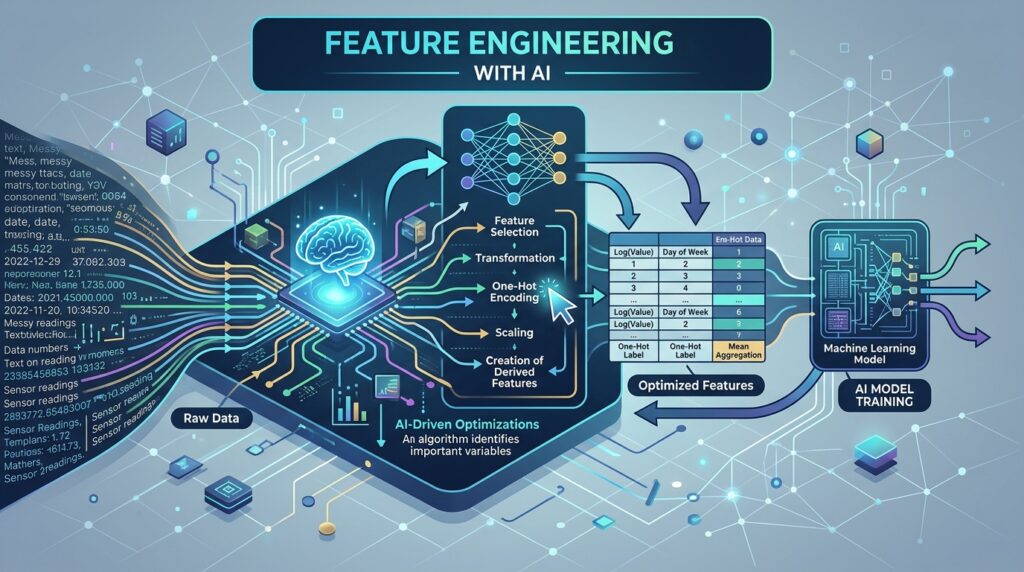
How AI Automates Feature Engineering
AI uses multiple techniques to engineer features.
Each technique serves a specific purpose.
Below are the most effective approaches.
Automated Feature Extraction
First, AI extracts features directly from raw data.
This approach works well for images and text.
For example, deep learning finds visual patterns.
Meanwhile, NLP models understand text meaning.
As a result, manual preprocessing becomes unnecessary.
Read more: Computer Vision in AI: A Complete Beginner-Friendly Guide
Feature Transformation with AI
Next, AI transforms existing features intelligently.
Scaling and encoding happen automatically.
Furthermore, AI selects the best transformation method.
This decision depends on data distribution.
Consequently, overall data quality improves.
Feature Selection Using AI
Not every feature is useful.
Some features create noise.
AI identifies irrelevant variables quickly.
Then, unnecessary features are removed.
Because of this pruning, training becomes faster.
Additionally, model interpretability improves.
Feature Generation Through AI
AI can also generate new features.
These features combine existing variables.
For example, ratios and interactions appear automatically.
As a result, deeper insights are uncovered.
This ability defines advanced Feature Engineering with AI.
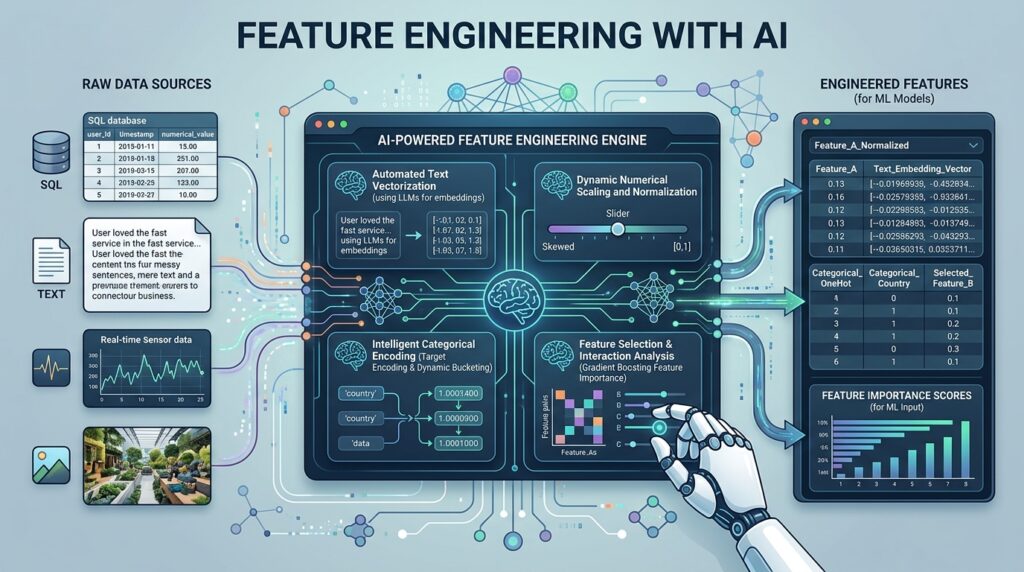
Benefits of Feature Engineering with AI
AI-driven feature engineering provides many advantages.
Each benefit improves performance and scalability.
Jasper AI (AI Writing & Content Tool)👇
Faster Model Development
Manual feature creation takes weeks.
In contrast, AI completes tasks quickly.
Therefore, teams deliver models faster.
As a result, innovation accelerates.
Higher Accuracy
AI discovers complex relationships in data.
Therefore, Humans often miss these patterns.
Consequently, AI-trained models perform better.
Accuracy improves across datasets.
Read more: Unsupervised Learning in AI: A Clear & Easy Guide
Reduced Human Bias
Human decisions can introduce bias.
AI focuses on data-driven patterns.
Because of this, outcomes become more objective.
Fairness improves in sensitive use cases.
Scalability Across Projects
Manual processes do not scale well.
AI handles large datasets easily.
Thus, feature pipelines are reused efficiently.
Productivity increases across teams.
Feature Engineering with AI in Real-World Use Cases
Today, AI-driven feature engineering is widely adopted.
Many industries benefit from this approach.
Finance and Banking
In finance, risk prediction is essential.
so, AI generates transactional and behavioral features.
As a result, fraud detection improves.
Credit scoring also becomes more accurate.
Healthcare Analytics
Medical data is complex and sensitive.
AI extracts meaningful signals from records.
Therefore, diagnostic models become reliable.
Personalized treatments also improve.
Read more: Powerful Guide to Gemstone Names and Colors for Beginners
E-Commerce and Marketing
Customer behavior generates massive data.
AI engineers features from clicks and purchases.
Consequently, recommendation systems perform better.
Customer retention also increases.
Manufacturing and IoT
Sensor data streams continuously.
AI creates time-based features automatically.
Thus, predictive maintenance becomes possible.
Downtime reduces significantly.

Popular Tools for Feature Engineering with AI
Several tools simplify AI-based feature engineering.
Each option offers unique strengths.
Read more: Best Data Mining Tools for Big Data & Analytics
DataCamp (Data Science Learning Platform)👇
Data Science for Sustainable Development Goals: Indian Case Studies
AutoML Platforms
AutoML tools automate complete workflows.
Feature engineering is included by default.
Many platforms are cloud-based.
Both beginners and experts benefit.
Feature Stores
Feature stores manage reusable features.
AI pipelines integrate smoothly.
As a result, consistency improves.
Team collaboration becomes easier.
Python Libraries
Python provides powerful libraries.
These tools support automated feature creation.
Therefore, developers maintain flexibility.
Customization remains possible.
Read more: Python Tutorial: A Simple and Beginner-Friendly Guide 2026
Best Practices for Feature Engineering with AI
Although AI automates work, best practices still matter.
Following guidelines ensures reliable results.
Understand the Data First
AI performs best with clean data.
Understanding data sources is critical.
Thus, always validate data quality.
Fix errors early.
Coursera Machine Learning Courses👇
Hands-On Machine Learning with Scikit-Learn, Keras, and TensorFlow
Combine Domain Knowledge with AI
AI is powerful but imperfect.
Human insight adds valuable context.
Therefore, combine expertise with automation.
Results become more meaningful.
Monitor Feature Drift
Data changes over time.
Features may lose relevance.
AI systems must detect drift.
Regular retraining maintains accuracy.
Read more: PyTorch Basics to Advanced: A Complete Learning Guide 2026
Keep Interpretability in Mind
Complex features reduce transparency.
Trust depends on understanding.
Thus, balance performance and explainability.
Stakeholders value clarity.

Challenges of Feature Engineering with AI
Despite benefits, challenges remain.
Awareness helps reduce risks.
Computational Costs
AI processing requires resources.
Large datasets increase costs.
Therefore, efficient infrastructure is necessary.
Optimization helps control expenses.
Over-Automation Risks
Blind automation can create useless features.
Quality checks remain important.
As a result, human review is essential.
Balance automation with oversight.
Data Privacy Concerns
Sensitive data needs protection.
AI pipelines must follow regulations.
Hence, privacy-preserving methods are vital.
Security should never be ignored.
Read more: PCA in Python Made Easy: Basic and Easy Guide
The Future of Feature Engineering with AI
Feature engineering continues to evolve.
AI will dominate future workflows.
Real-time adaptation will become standard.
Self-learning pipelines will expand.
Moreover, explainable AI will improve trust.
Transparency will increase adoption.
Ultimately, Feature Engineering with AI will become the norm.
Manual methods will fade away.
Frequently Asked Questions (FAQs)
What is Feature Engineering with AI?
Feature Engineering with AI uses AI to derive features from raw data. As a result, machine learning models can learn patterns more easily. This often improves predictions.
Why is feature engineering important in machine learning?
Features guide how a model learns. Without strong features, results can suffer. Therefore, feature engineering is critical for model success.
How does AI improve feature engineering?
AI analyzes large datasets quickly. In addition, it can spot hidden patterns. As a result, feature creation becomes faster and more effective.
Is Feature Engineering with AI better than manual feature engineering?
AI saves time and reduces manual work. However, human expertise still matters. Together, they often produce the best results.
Can beginners use Feature Engineering with AI?
Yes, they can. Many AutoML tools simplify the process. Consequently, beginners can get started with little coding.
Which industries use Feature Engineering with AI?
Many industries use it today. For example, finance uses it for fraud detection. Likewise, healthcare applies it to disease prediction. E-commerce also benefits from it.
Does Feature Engineering with AI improve model accuracy?
In many cases, yes. Better features help models learn more effectively. As a result, predictions become more accurate.
Are there any risks involved?
Yes, some risks exist. Poor data can affect results. Therefore, testing and validation remain important.
Read more: Text-to-Speech: A Complete Guide for Better Digital Content
Final Thoughts
Feature engineering is a key part of machine learning. In the past, it required significant manual effort. Today, AI makes the process easier.
By automating tasks, AI saves time. At the same time, it finds valuable patterns in data. Consequently, models become more accurate and efficient.
Most importantly, AI helps teams build better solutions faster. As technology advances, its impact will continue to grow.
If you want stronger models and faster results, consider using AI for Feature Engineering.
Call To Action
Need SEO content that ranks on Google and keeps readers engaged?
I create:
- SEO blog posts
- Keyword-focused articles
- Human-style content
- Easy-to-read blogs
- High-engagement website content
Let’s build content that performs.
📧 Email: craziya167@gmail.com
Author Bio:
Raziya is an SEO content writer specializing in AI, technology, and digital marketing. Her goal is to create clear, engaging, and easy-to-understand content for online readers.












Post Comment
You must be logged in to post a comment.