Machine Learning for Beginners: A Practical Guide (2026)
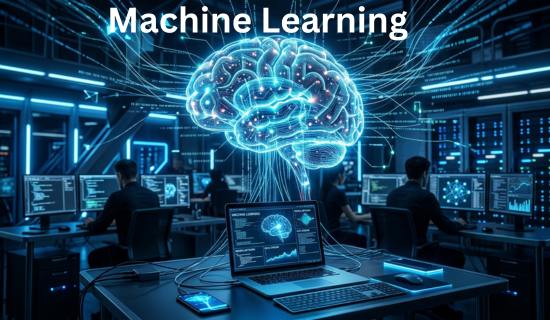
Introduction to Machine Learning
Technology is changing faster than ever. Because of this, people now hear terms like AI and machine learning almost everywhere.
For example, YouTube recommends videos based on your interests. Similarly, Google Maps shows live traffic updates in real time. In both cases, smart systems work quietly in the background.
Today, this technology is growing rapidly across the world. In fact, businesses, schools, hospitals, and shopping apps now use intelligent tools daily to improve services and user experience.
So, if you are searching for a beginner-friendly guide, you are in the right place.
Fortunately, you do not need advanced math or expert coding skills to begin. Instead, you only need curiosity, patience, and regular practice.
Therefore, let’s understand everything step by step in the easiest way possible.
Read More: Machine Learning by Example: A Simple Guide for Beginners
What Is Machine Learning in Simple Words?
Machine learning is a branch of Artificial Intelligence (AI). It allows computers to learn from data instead of following fixed instructions every time.
Simply put, machines learn from examples.
For instance, a child slowly learns to recognize cats after seeing many cat pictures. In the same way, AI systems study data and recognize patterns over time.
Instead of writing every rule manually, developers provide:
- Data
- Examples
- Feedback
As a result, the system improves automatically.
That is the basic idea behind machine learning.
A Real-Life Example of Smart Systems

Have you ever wondered why YouTube recommends videos you actually enjoy watching?
Well, that happens because of recommendation algorithms.
The platform studies:
- What videos you watch
- What videos you skip
- How long you watch
- What you search for
Then, after analyzing your behavior, it predicts what you may enjoy next.
Over time, the recommendations become smarter, faster, and more accurate.
Pretty interesting, right?
Why This Technology Matters Today
A few years ago, AI tools were mostly used by large tech companies. However, things have changed very quickly.
Today, almost every industry uses intelligent systems in some way.
For example:
- Hospitals use predictive tools to help detect diseases
- Banks use AI systems to identify fraud
- Schools use smart software for personalized learning
- Shopping apps use recommendation engines for product suggestions
Because of this, AI-related skills are becoming more valuable every year.
Moreover, as technology continues improving, the demand for these skills keeps increasing worldwide.
Read More: Google Colab: The Ultimate Guide for Beginners (2026)
Main Benefits of AI-Powered Systems in Machine Learning
These systems offer many advantages. As a result, companies around the world are investing heavily in modern AI tools.
| Benefit | How It Helps |
|---|---|
| Saves Time | Automates repetitive tasks |
| Improves Accuracy | Reduces human mistakes |
| Better Decisions | Uses data for predictions |
| Personalization | Improves user experience |
| Career Growth | Creates new job opportunities |
Clearly, intelligent technology is changing how businesses work today.
Industries Using Intelligent Technology

Today, AI-powered systems are used almost everywhere. In fact, many people use these services daily without even realizing it.
| Industry | Common Use |
|---|---|
| Healthcare | Disease prediction |
| Education | Smart learning systems |
| Finance | Fraud detection |
| E-commerce | Product recommendations |
| Marketing | Customer analysis |
| Cybersecurity | Threat detection |
Previously, many of these tasks were completed manually. Now, however, advanced systems can perform them much faster and more accurately.
How These Systems Work Step by Step in Machine Learning
At first, the process may sound complicated. Terms like algorithms and data models can confuse beginners.
However, once you break everything into smaller steps, the process becomes much easier to understand.
Step 1: Collecting Data
Every AI model starts with data.
Without data, computers cannot learn anything.
This information may include:
- Images
- Videos
- Text
- Numbers
- Audio files
For example, shopping apps study customer purchases to recommend products. Similarly, schools analyze student records to predict performance.
So, better data usually leads to better results.

Step 2: Cleaning and Preparing Information
Raw data is often messy.
Sometimes information is missing. In other cases, duplicate entries or mistakes appear.
Therefore, developers clean the information before using it.
This process includes:
- Removing duplicate data
- Fixing mistakes
- Organizing information
- Handling missing values
This step is known as data preprocessing.
Although many beginners ignore it, this is actually one of the most important stages.
Read More: The Ultimate Guide to Software for SEO Optimization in 2026
Step 3: Choosing the Right Algorithm
An algorithm is simply a method that helps computers learn patterns from data.
Different problems require different algorithms.
Some beginner-friendly options include:
| Algorithm | Main Purpose |
|---|---|
| Linear Regression | Predicts numbers |
| Logistic Regression | Classification tasks |
| Decision Trees | Makes decisions |
| K-Nearest Neighbors | Finds similarities |
For example, weather apps use prediction algorithms. Meanwhile, email services use classification systems to detect spam emails.
Step 4: Training the Model
During training, the system studies data repeatedly.
Then, it searches for patterns and slowly improves its predictions.
Think of it like preparing for an exam. The better the practice material, the better the final results become.
However, poor-quality data usually creates weak predictions.
Because of this, high-quality information is extremely important.
Read More: Discover the Best AI Models You Should Know in 2026
Step 5: Testing and Improving Results
After training, the model is tested using new data.
This helps developers check whether the system performs properly in real-world situations.
If the results are weak, developers may:
- Improve the data
- Change settings
- Use another algorithm
- Train the system again
As a result, the software becomes more accurate over time.
Main Types of Learning Methods

There are three major learning methods used in AI.
Now, let’s understand them one by one.
Read More: Ultimate Guide to K-Means Clustering Made Simple
Supervised Learning Explained
In supervised learning, the system learns from labeled data.
In simple words, the correct answers already exist.
Examples include:
| Input | Output |
|---|---|
| House size | House price |
| Email content | Spam or not spam |
| Student marks | Pass or fail |
The system studies these examples and learns relationships.
For instance, Gmail uses this method to filter spam emails.
Read more: Supervised Learning in 2026: Best Methods, Models, and Uses
Understanding Unsupervised Learning
In unsupervised learning, the data has no labels.
So, the system tries to discover hidden patterns on its own.
This method is often used for:
- Customer grouping
- Market analysis
- Product categorization
For example, shopping websites group customers based on buying habits.
Read more: Unsupervised Learning in AI: A Clear & Easy Guide
Reinforcement Learning for Beginners
Reinforcement learning works through rewards and penalties.
The system learns by repeatedly trying actions.
Correct actions receive rewards. On the other hand, wrong actions receive penalties.
This method is commonly used in:
- Robotics
- AI games
- Self-driving systems
For example, AI chess systems improve after playing thousands of games.
Read more: Reinforcement Learning in 2026: A Complete Beginner Guide
Everyday Applications of Machine Learning

Today, smart technology is already part of everyday life.
Some common examples include:
| Application | Main Function |
|---|---|
| Netflix | Movie recommendations |
| Google Maps | Traffic prediction |
| Banking apps | Fraud detection |
| Smartphones | Face unlock |
| Shopping apps | Product suggestions |
In addition, social media platforms also use AI systems to recommend content users may enjoy.
Do You Need Coding Skills to Start?
Many beginners believe AI requires advanced coding skills from day one.
Fortunately, that is not true.
At first, you should focus on understanding concepts like:
- Data
- Patterns
- Predictions
- Algorithms
Later, coding becomes important for building projects and working with datasets.
Python is the most popular programming language because it is simple and beginner-friendly.
Read more: AI Coding Tools Explained: How to Code Faster with Artificial Intelligence
Best Laptops for Machine Learning Beginners
- ASUS Vivobook Go 15.6” Slim Laptop, AMD Ryzen 5 7520U, 8GB, 512GB, Windows 11 Home, Cool Silver, Military Grade Durability, Fast Charging, Webcam Shield, E1504FA-AS54
- 2023 Apple MacBook Air with Apple M2 Chip with 8-Core CPU/10-Core GPU (15-inch, 8GB RAM, 256GB SSD Storage) (QWERTY English) Starlight (Renewed Premium)
- Lenovo IdeaPad Slim 3X – 2025 – Everyday AI Laptop – Copilot+ PC – 15.3″ WUXGA Display – 16 GB Memory – 512 GB Storage – Snapdragon® X – Luna Grey
Best Beginner Tools for Machine Learning
The best part?
You do not need expensive equipment to get started.
Today, several beginner-friendly tools are available online.
Best Online Courses to Learn Machine Learning
- BEYOND COURSES: The Course-First Reflex Is Costing L&D Credibility: Move From Course Production to Capability Architecture Kindle Edition
- Udemy Machine Learning Courses
- Google AI Certificates
| Tool | Purpose |
|---|---|
| Google Colab | Cloud-based notebooks |
| Kaggle | Practice datasets |
| Scikit-learn | Beginner AI library |
| Coursera | Online learning courses |
Most beginners start with only a browser and an internet connection.
Honestly, that is more than enough in the beginning.
Final Thoughts
At first, learning these concepts may seem difficult. However, once you understand the basics, everything becomes much easier.
So, start small.
Then, practice regularly.
After that, build simple projects.
Most importantly, stay curious.
Because today, machine learning is no longer just a technical skill. Instead, it is becoming an essential digital skill for the future.
Frequently Asked Questions (FAQs)
What is machine learning?
Machine learning is a type of AI that helps computers learn from data. As a result, systems can improve automatically over time.
Why is machine learning important?
Machine learning helps businesses save time, improve accuracy, and make smarter decisions. Therefore, many industries use it today.
Where is machine learning used?
Machine learning is used in YouTube, Netflix, Google Maps, shopping apps, and social media platforms. In fact, people use it daily without realizing it.
Is machine learning hard for beginners?
No, machine learning is beginner-friendly if you learn step by step. Moreover, many free resources are available online.
Do I need coding skills for machine learning?
At first, coding is not necessary. However, later you will need basic programming skills for projects.
Which language is best for machine learning?
Python is the best language for machine learning because it is simple and easy to learn.
What are the main types of machine learning?
The main types are:
- Supervised learning
- Unsupervised learning
- Reinforcement learning
Each method is used for different tasks.
How long does it take to learn machine learning?
Usually, beginners can learn the basics in a few months. However, regular practice is important.
What tools can beginners use?
Beginners often use:
- Google Colab
- Kaggle
- Scikit-learn
- Coursera
These tools make learning easier.
Can machine learning replace jobs?
Machine learning can automate some tasks. However, it also creates many new career opportunities.
Call To Action
Need SEO content that ranks on Google and keeps readers engaged?
I create:
- SEO blog posts
- Keyword-focused articles
- Human-style content
- Easy-to-read blogs
- High-engagement website content
Let’s build content that performs.
📧 Email: craziya167@gmail.com
📱 WhatsApp: +92 371 4778412
Author Bio:
Raziya is an SEO content writer specializing in AI, technology, and digital marketing. Her goal is to create clear, engaging, and easy-to-understand content for online readers.









Post Comment
You must be logged in to post a comment.