How to Check Your AI Search Visibility: Free 2026 Guide
Check Your AI Search Visibility Free in Seconds
Most websites are still optimizing only for Google.
That is already outdated.
Today, users search through AI systems like ChatGPT, Gemini, Claude, Perplexity, and Copilot. These AI engines do not rank websites the same way traditional search engines do. If your brand is invisible inside AI-generated answers, you are losing future traffic before competitors even realize what is happening.
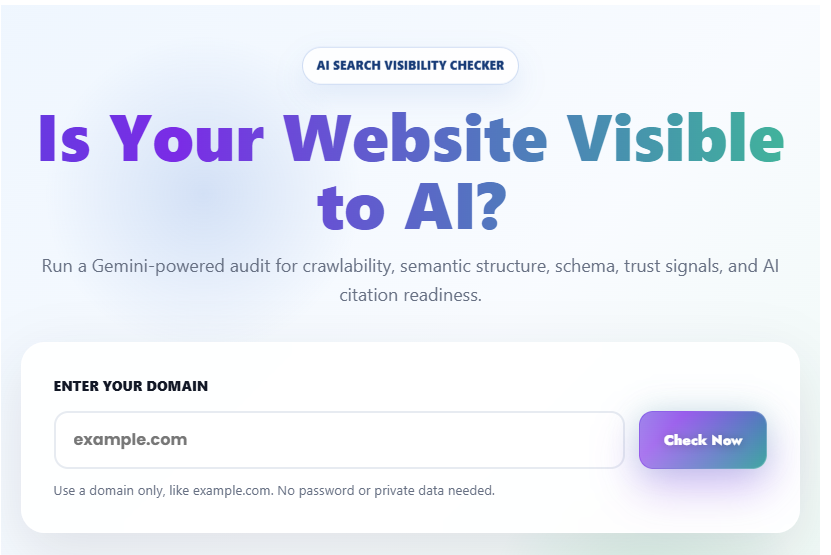
That is exactly why we built our AI Search Visibility Checker.
It helps you discover:
- Whether AI systems can find your brand
- How often does your website appears in AI-generated answers
- Which competitors dominate AI search visibility
- What technical and content gaps are hurting your discoverability
- How optimized your site is for LLM indexing
👉 Try our free AI Search Visibility Check tool now and see how visible your website is across AI-powered search systems.
What Is AI Search Visibility?
AI search visibility refers to how often your website, pages, or brand appear inside AI-generated search responses.
Traditional SEO focuses on ranking webpages in search engine results pages.
AI visibility focuses on whether large language models and AI assistants:
- Mention your brand
- Reference your content
- Use your website as a trusted source
- Recommend your business in generated answers
- Surface your pages in conversational search
This is a massive shift.
Instead of users clicking 10 blue links, AI engines now summarize answers directly. If your business is not included in those summaries, your visibility drops dramatically even if your Google rankings look strong.
That is why AI optimization is becoming one of the most important digital marketing strategies in 2026.
Why AI Search Visibility Matters in 2026
The search industry is changing faster than most businesses understand.
Users are now asking questions like:
- “Best AI SEO tools”
- “Top agencies for local SEO”
- “What software helps track AI visibility?”
- “Best platforms for GEO optimization”
And instead of browsing websites manually, they trust AI-generated recommendations.
If your website is not optimized for AI retrieval systems, you risk:
- Losing organic traffic
- Reduced brand mentions
- Lower authority signals
- Declining click-through rates
- Weak AI discoverability
- Competitors dominating conversational search
The uncomfortable truth:
Most websites are structurally invisible to AI systems.
They publish generic SEO content, weak entity signals, thin expertise pages, and poorly structured information architecture. AI systems struggle to trust or reference them.
What Is an AI Search Visibility Checker?
An AI Search Visibility Checker analyzes how discoverable your website is inside AI-powered search ecosystems.
Unlike traditional SEO audit tools, AI visibility tools focus on:
AI Retrieval Optimization
Can AI systems access and understand your content properly?
Entity Recognition
Does your brand appear as a recognizable entity?
Structured Content Signals
Is your content organized in a way AI systems can summarize?
Conversational Query Coverage
Can your pages answer natural-language questions?
Brand Mention Analysis
How often does your brand appear across AI-generated results?
Competitor Gap Detection
Which competitors are dominating AI citations?
Our tool combines these visibility signals into a single AI Visibility Score.
How to Check Your AI Search Visibility
Here is the exact process smart brands are using in 2026.
1. Analyze Your Domain
Enter your website URL into the AI Search Visibility Checker.
The system scans:
- AI discoverability
- Crawlability
- Entity signals
- Content structure
- AI answer compatibility
- GEO optimization factors
This gives you a baseline AI visibility score.
2. Compare Against Competitors
This is where most businesses expose the real problem.
Many websites think they are doing well because they rank on Google.
But when compared against competitors inside AI-generated search systems, they disappear completely.
Competitor analysis reveals:
- Visibility gaps
- Missing topical authority
- Weak citation signals
- Content depth differences
- AI mention frequency
The companies dominating AI search are usually not the ones relying on old SEO tactics.
3. Audit Page-Level AI Optimization
Domain-level analysis alone is not enough.
AI systems often evaluate individual pages separately.
Important pages to analyze include:
- Homepage
- Service pages
- Blog articles
- Comparison pages
- Tool landing pages
- FAQ pages
Weak page structure kills AI visibility.
4. Improve Conversational Search Readiness
AI systems prioritize content that answers human questions directly.
That means your content should include:
- Natural language phrasing
- Question-based headings
- Clear explanations
- Concise summaries
- Expert-level depth
- Structured formatting
This is where Answer Engine Optimization (AEO) becomes critical.
AI SEO vs Traditional SEO
Many people still think AI SEO is just normal SEO with different branding.
That assumption is wrong.
Traditional SEO Focuses On:
- Keyword rankings
- Backlinks
- SERP positions
- Technical indexing
- Click-through optimization
AI SEO Focuses On:
- Entity authority
- Context understanding
- Citation-worthiness
- Conversational relevance
- Trust signals
- Semantic structure
- AI retrievability
Traditional SEO helps users find pages.
AI SEO helps AI systems trust and recommend your content.
Both matter now.
What Is GEO Optimization?
GEO stands for Generative Engine Optimization.
It is the process of optimizing content specifically for generative AI systems like:
- ChatGPT
- Gemini
- Claude
- Perplexity
- Copilot
GEO optimization improves the likelihood that AI systems:
- Mention your brand
- Cite your website
- Recommend your services
- Surface your content in generated responses
This is becoming the next major evolution of search marketing.
Key Factors That Affect AI Visibility
1. Strong Topical Authority
AI systems trust websites that deeply cover a topic.
Thin content loses visibility.
Comprehensive expertise wins.
2. Entity-Based SEO
Your brand needs consistent identity signals across:
- Website pages
- Social platforms
- Citations
- Mentions
- Structured data
AI models rely heavily on entity understanding.
3. Structured Information Architecture
Messy websites confuse AI systems.
Clear hierarchy improves discoverability.
Use:
- FAQ sections
- Semantic headings
- Topic clusters
- Internal linking
- Clean navigation
4. Original Insights
AI systems increasingly prioritize unique information.
Generic rewritten content performs poorly.
If your content sounds identical to everyone else, AI systems have no reason to reference you.
5. Machine-Readable Formatting
AI retrieval systems favor content that is easy to parse.
Use:
- Lists
- Tables
- Definitions
- Step-by-step breakdowns
- FAQ blocks
- Structured answers
Common Reasons Websites Fail AI Visibility Checks
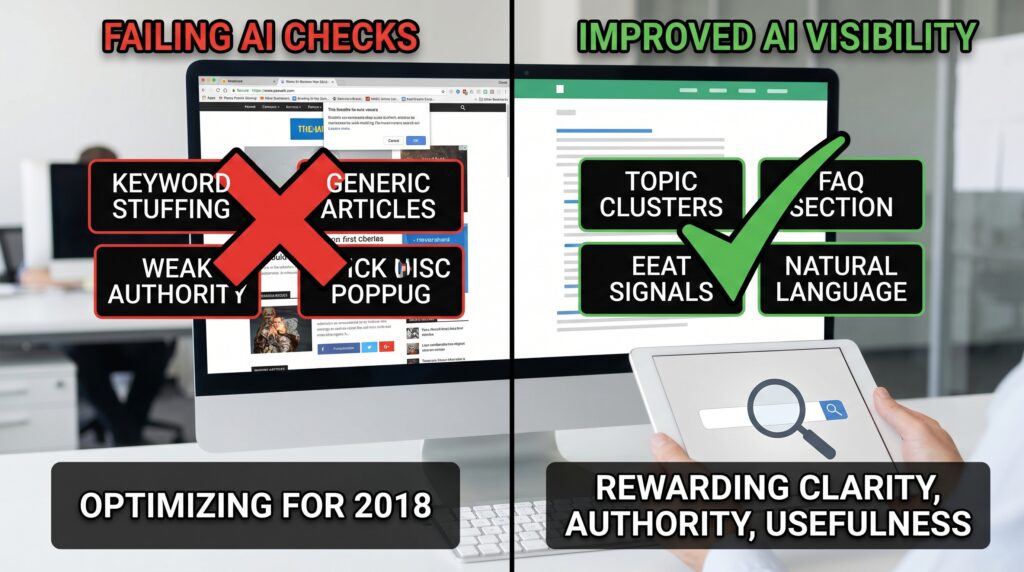
Most websites fail because they are still optimizing for 2018 search behavior.
Common mistakes include:
- Keyword stuffing
- Generic AI-written articles
- Weak entity authority
- No schema markup
- Poor content depth
- No topical clustering
- Thin service pages
- Weak internal linking
- Missing FAQs
- Lack of trust signals
AI systems reward clarity, authority, and usefulness.
Not manipulation.
Best Practices to Improve AI Search Visibility
Build Topic Clusters
Create interconnected content around a central topic.
This improves semantic authority.
Add FAQ Section
AI systems love direct question-answer formatting.
It improves retrieval and summarization.
Improve EEAT Signals
Demonstrate:
- Experience
- Expertise
- Authority
- Trustworthiness
Without trust signals, AI systems hesitate to reference your content.
Optimize for Natural Language Queries
Humans search conversationally now.
Your content should match that behavior.
Create Citation-Worthy Content
Publish original research, frameworks, comparisons, and insights.
AI systems prefer content worth referencing.
The Future of AI Search
AI search is not replacing SEO.
It is replacing lazy SEO.
Businesses that adapt early will dominate visibility while competitors remain stuck optimizing only for outdated ranking systems.
The biggest mistake right now is assuming this shift is still “coming.”
It already happened.
The companies getting cited by AI systems today are building the next generation of organic traffic advantages.
Everyone else will spend the next few years trying to catch up.
Final Thoughts
If you want your business to stay discoverable in 2026 and beyond, you need more than traditional SEO rankings.
You need AI visibility.
That means understanding how AI systems interpret, retrieve, trust, and recommend your content.
Our AI Search Visibility Checker helps you uncover the exact gaps limiting your visibility across modern AI search platforms.
Frequently Asked Questions
What is AI search visibility?
AI search visibility measures how often your brand or website appears in AI-generated answers from systems like ChatGPT, Gemini, Claude, and Perplexity.
What is an AI visibility score?
An AI visibility score estimates how optimized your website is for AI discoverability, retrieval, and citation.
How is AI SEO different from traditional SEO?
Traditional SEO focuses on search engine rankings, while AI SEO focuses on how AI systems understand, trust, and reference your content.
What does GEO mean in SEO?
GEO stands for Generative Engine Optimization. It involves optimizing content for AI-powered search systems and large language models.
Why is my website not appearing in AI-generated answers?
Common reasons include weak authority signals, poor structure, generic content, missing entity optimization, and lack of conversational relevance.
Can AI visibility improve website traffic?
Yes. As more users rely on AI-generated answers, better AI visibility can increase brand mentions, referrals, authority, and organic traffic.
Is AI search optimization important for small businesses?
Absolutely. Smaller brands can compete effectively in AI search by publishing structured, authoritative, and specialized content.
How often should I check AI visibility?
At least monthly. AI systems evolve rapidly, and competitor visibility can change quickly.









Post Comment
You must be logged in to post a comment.