
Decoding AI Scores: The Ultimate Guide for Publishers
If you have ever pasted a paragraph into an online scanner and stared anxiously at the results, you are not alone. With the massive boom in generative artificial intelligence, a new metric has taken over the digital world: the ai scores.
Whether you are a student trying to turn in an essay, a freelance writer delivering a draft to a client, a blogger aiming for the top of search engine result pages, or an editor reviewing a massive content calendar, understanding these metrics is incredibly important. However, as these tools have spread across the internet, so has a massive wave of confusion, anxiety, and misinformation regarding what these percentages actually mean.
moreover, If you have found yourself stressed out over a high percentage on a piece of content you wrote entirely from scratch, or if you are trying to understand how to navigate the future of digital publishing responsibly, you are in the right place.
Let us pull back the curtain, debunk the myths, and break down everything you need to know about ai scores in simple, plain English.
read more : ChatGPT AI: A Simple Guide for Better Work and SEO
1. What Exactly is an AI Score?
Put simply, an ai score is a numerical value—usually a percentage ranging from 0% to 100%—generated by an artificial intelligence detector. Its primary purpose is to estimate how closely a specific piece of text mirrors the patterns typically found in machine-generated writing.
However, this is precisely where most people get tripped up, often leading to unnecessary panic.
The Biggest Misconception: An ai score of 70% does not mean that 70% of your article was written by a chatbot like ChatGPT. It also does not mean that 70% of the words on the page are “guilty” of being artificial.
Instead, it means that the detection tool is 70% confident that the text follows machine-generated patterns. Think of it exactly like a weather forecast. If your local meteorologist says there is a 70% chance of rain tomorrow, it does not mean that 70% of the sky will drop water or that 70% of your town will get soaked. It simply means that, based on all available data, the experts are 70% certain that rain will occur.
When an AI detector outputs high ai scores, it is stating that the linguistic data in your text looks incredibly familiar to the data maps it has stored for machine text.
AI Scores vs. Plagiarism Scores
To truly grasp how these tools work, it is crucial to understand that AI detection and plagiarism detection are completely different beasts.
- Plagiarism Checkers (like Turnitin or Copyscape): These tools look backward. They search a massive, constantly updating database of existing web pages, academic journals, books, and previously submitted papers to see if you copied someone else’s exact words. They are looking for literal matches. If you copy a sentence word-for-word from a Wikipedia page, a plagiarism checker flags it.
- AI Detectors (like Originality.ai, GPTZero, or Winston AI): These tools look inward. They do not care if your text is 100% unique to the world. You could write a completely original theory that has never been published on the internet, but if you write it using highly predictable, repetitive language, the detector will give you high ai scores. AI detectors analyze the internal DNA, structure, and rhythm of the writing itself.
Because of this difference, a blog post can easily pass a traditional plagiarism test with a perfect 0% duplicated content rating, while simultaneously triggering a 100% artificial rating on an AI scanner.
read more : The Ultimate Beginner’s Guide to Blackbox AI: Features, Benefits, and Comparison

2. How Do AI Detectors Calculate These Scores?
To understand how a machine grades your writing, you first have to understand how large language models like ChatGPT, Claude, and Gemini write in the first place.
At their core, AI models are essentially super-advanced guessing machines. They do not “think” or feel inspired. Instead, they use mathematical probabilities to predict the most logical next word in a sentence based on the massive datasets they were trained on.
Because AI text is generated through mathematical probability, it leaves behind a distinct mathematical footprint. AI detectors are trained to spot this footprint by analyzing two main linguistic concepts: perplexity and burstiness.
Firstly, the tool looks at Perplexity, which is the predictability factor If a sentence follows a highly predictable path, its perplexity is low. For example, if a text reads, “The cat sat on the…”, the most statistically probable next word is “mat” or “floor”. If an AI writes this, it will almost always choose the high-probability word. On the other hand, if a human writes that same sentence, they might say, “The cat sat on the laptop keyboard while I was trying to submit my tax forms.” This choice of words is highly creative, unexpected, and specific.
Second, the tool looks at Burstiness, which is the rhythmic variety factor. Humans are natural storytellers, and our emotions heavily influence our physical writing style. When humans write, our content features a high level of variation. A human writer might construct a long, beautifully descriptive sentence to paint a picture, follow it up with a tiny, sharp sentence for emphasis, and then transition into a medium-sized list. AI models, on the other hand, are highly structured and uniform. They are programmed to be clean, polite, and balanced. As a result, machine-generated text tends to feature sentences that are roughly the same length, utilize the exact same grammatical rhythm, and follow an unyielding subject-verb-object template.
read more : Artificial Intelligence New Technology: Latest AI News & Trends
3. Breaking Down the Percentages: What Do They Mean?
Because every AI detection software developer uses a slightly different proprietary algorithm, there is no universal industry standard for what a specific number means. A tool optimized to catch newer models might give your article a 10% rating, while an older detector might flag it at 60%.
However, looking at the industry at large, we can create a helpful framework to interpret ai scores using this comprehensive breakdown:
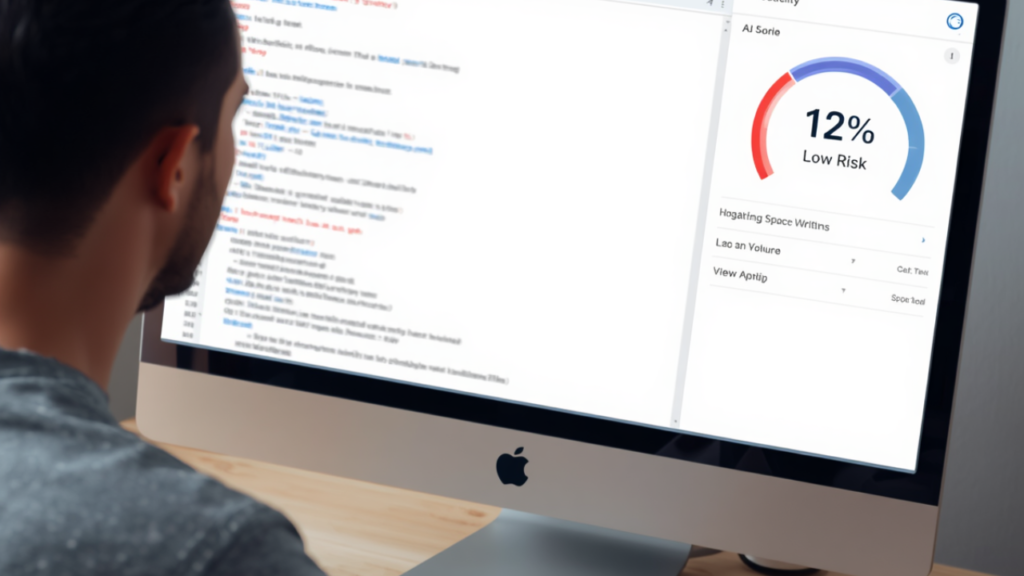
- 0% to 20% (Low Risk): The text looks highly human. It features natural linguistic quirks, highly uneven sentence lengths, unique phrasing, and a distinct voice. Search engines and editors will easily accept this. No action is required.
- 21% to 50% (Medium Risk): Mixed signals. This gray area often occurs if you wrote the draft yourself from scratch but relied heavily on an AI-powered grammar assistant to heavily polish, rephrase, or clean up your work. A light review is recommended to check for overly formal transitions.
- 51% to 80% (High Risk): The text heavily mirrors machine-generated patterns. It likely contains generic summaries, repetitive structural templates, or minimal human editing. It risks being flagged by strict editorial teams and needs heavy editing.
- 81% to 100% (Very High Risk): The detector is almost entirely certain the text was copied straight from an AI prompt box with little to no human intervention. The language is highly predictable and uniform throughout. It requires a complete overhaul to infuse real-life context and stylistic flavor.

4. Why Do Human-Written Articles Get Flagged? (The False Positive Problem)
One of the absolute biggest frustrations for modern content creators, students, and digital marketers is getting sky-high ai scores on an article, essay, or guide that they spent hours writing entirely by hand. This painful mistake is known as a false positive.
To understand how systemic this issue is, we have to look no further than historic documents. When run through popular AI detectors, the United States Constitution, the Bible, and various plays by William Shakespeare frequently return incredibly high ai scores—sometimes up to 90% or higher.
So, why does this happen to honest human writers? It usually comes down to three distinct factors:
read more : Jupiter Notebook: A proven Tool That Makes Coding Effortless
Over-Optimized Grammar Tools
If you use advanced grammar checkers very aggressively to fix every single tiny flaw, passive voice issue, or stylistic variation in your draft, you are inadvertently stripping away your human writing identity. These optimization tools are built on AI models that are programmed to make text as clean and standard as possible. Ironically, by letting a tool fix every single sentence to meet a flawless standard, your writing becomes too perfect. Because human writing is naturally flawed and quirky, flawless and rigid grammar looks exactly like a machine output to a detector.
Formulaic or Academic Writing Style
Academic papers, medical journals, legal briefs, technical documentation, and standard SEO recipes use highly standardized, repetitive phrasing by design. For example, if you are writing a guide on how to file a specific tax form, there are only so many ways to explain the step-by-step process clearly. Because the industry-standard format is fixed and relies on highly specific technical terms, detectors mistake this objective, professional structure for an AI pattern. If you write with absolute neutrality, you write like a machine.
Short Content Length
AI detection tools require data to make accurate calculations. The shorter the text sample, the less data the tool has to analyze. If you paste a single sentence or a brief 50-word product description into a scanner, the detector simply does not have enough mathematical context to judge the variety accurately. This lack of data frequently results in heavily skewed, wildly inaccurate ai scores that do not reflect reality.
5. The E-E-A-T and AEO Connection: Why AI Scores Matter for Modern SEO
To succeed in digital marketing and content publishing, you cannot look at ai scores in isolation. You must understand how they intersect with modern search engine guidelines, specifically E-E-A-T and AEO.
Decoding E-E-A-T
Google’s Search Quality Rater Guidelines heavily emphasize four main pillars for evaluating content quality: Experience, Expertise, Authoritativeness, and Trustworthiness (E-E-A-T). Search engines want to reward content that provides genuine value to users. AI generators are highly skilled at summarizing existing internet data, but they lack the capacity for true human experience. They cannot try a product, visit a hotel, conduct a physical science experiment, or feel a human emotion.
When an article features incredibly high ai scores, it signals to search engines and sophisticated editors that the content might just be a recycled, low-effort summary of information that already exists elsewhere on the web. By focusing on lowering your machine score, you naturally elevate your E-E-A-T because you are forced to include elements that a machine cannot easily replicate.
Understanding AEO (Answer Engine Optimization)
As search behavior evolves, more users are shifting away from traditional keyword searches and moving toward conversational queries. People are asking voice assistants and AI-powered search engines direct questions like, “How do I fix a leaking pipe under my kitchen sink?” or “What do high ai scores mean for my website?”
Answer Engine Optimization (AEO) is the practice of structuring your content so that these conversational search engines can easily pull a clean, direct answer from your text. The challenge lies in balancing AEO with a human touch. While an AI search engine loves clear, direct, and straightforward definitions, writing too rigidly can cause your content to get flagged by detectors. The goal is to provide a razor-sharp, direct answer to the user’s question immediately, and then follow it up with your own deeply contextual, human explanation to keep your overall metrics balanced.
read more : Text-to-Speech:A simple and Complete AI Voice Guide for 2026
6. A Step-by-Step Guide to Maintaining Low AI Scores Naturally
If you want your content to perform exceptionally well under the eyes of search engine algorithms, picky editors, and automated scanners alike, the secret is remarkably simple: you must embrace your unique humanity. You do not need to use confusing, low-quality tools that swap out words for strange synonyms, which ultimately ruins the user experience. Instead, use these highly practical, proven strategies to ensure your writing stays authentic and keeps its ai scores naturally low:
Inject Tangible Personal Stories and Real-World Examples
Artificial intelligence cannot draw from a lifetime of real-life experiences. It does not remember a childhood memory, it has never made a mistake on a client project, and it has never felt the frustration of a failed experiment. Whenever you are writing an informative article, purposefully inject personal anecdotes, real-world case studies, or your specific professional opinions.
Instead of writing: “Time management is an important skill for freelance writers to develop in order to meet tight deadlines.” Try writing instead: “Back when I started freelancing, I completely blew a deadline for a major tech publication because I didn’t track my hours. That painful mistake taught me exactly why rigorous time management matters.” This single shift introduces highly unique vocabulary phrases, unexpected data paths, and personal context that instantly breaks up predictable machine patterns.
Intentionally Vary Your Sentence Rhythm and Length
As we discussed with sentence variety, a lack of rhythm is a massive red flag for automated detectors. To combat this, review your paragraphs with an ear for music and pacing. Purposely mix short, incredibly punchy sentences with longer, highly detailed explanations. Do not be afraid to use single-sentence paragraphs for emphasis. Look at how the rhythm of this very section changes from line to line. That stylistic variance is an inherently human trait that keeps reader engagement high while driving ai scores down.
Swap Out Generic, Robotic Transition Phrases
Large language models love formal, predictable transition words. If a scanner sees an abundance of phrases like “Furthermore,” “Moreover,” “In conclusion,” “It is important to note,” or “Crucial component,” it immediately flags the text as highly machine-like. Real people rarely use these phrases when speaking casually or writing engaging blogs. Swap them out for casual, natural alternatives:
- Instead of “Furthermore,” use “On top of that,” or “What’s more,”
- Instead of “Moreover,” use “Plus,” or “Also,”
- “In conclusion,” use “The takeaway is,” or “Ultimately,”
- “It is important to note,” use “Here is the thing,” or “Keep this in mind,”
Write Using a Conversational, Friendly Voice
Imagine you are sitting at a local coffee shop explaining the topic to a close friend. You wouldn’t use stiff, overly formal, textbook language. You would use active verbs, relatable metaphors, and occasional rhetorical questions. Writing in a conversational tone naturally introduces diverse vocabulary combinations and unexpected phrasing, which naturally creates high complexity scores that detectors love to see.
7. The Best AI Detection Tools on the Market Today
If you need to monitor the content quality of your website or check submissions from freelance creators, it helps to know which tools are leading the industry. Let us look at a quick comparison of the most popular platforms used to measure ai scores:
Originality.ai
This tool is best for professional digital marketers, SEO agencies, and website publishers who need highly sensitive detection. It is frequently updated to keep pace with the absolute newest releases of major AI language models. It offers excellent plagiarism detection and full site scanning capabilities. However, it is a paid tool, and its high sensitivity can occasionally lead to higher false-positive rates on highly optimized, clean human text.
GPTZero
This platform is best for educators, students, and casual content creators looking for a transparent breakdown. It features an incredibly user-friendly interface and offers a beautiful visual map that highlights exactly which specific sentences inside your text look human versus which ones look machine-generated. On the downside, it can occasionally be bypassed by minor stylistic edits or clever formatting tweaks.
Winston AI
This service is best for serious publishers and copywriters who want an incredibly clear, color-coded grading system. It boasts a remarkably high accuracy rate with very low false-positive reports on clean human text. It also features advanced optical character recognition technology to scan text directly inside images or scanned documents. Keep in mind that it requires a paid subscription plan to unlock its full suite of advanced capabilities.
read more : Predictive Analytics Made Simple for Modern Businesses
8. Emerging Trends: The Future of AI Content Scoring
As artificial intelligence moves forward, the technologies used to track it are changing fast. What started as simple scanners guessing word probabilities has evolved into a highly complex field. If you publish digital media, keep a close eye on these shifting trends:
Real-Time and Integrated Checking
Instead of forcing you to copy and paste text into an external website, automated scoring is moving directly into everyday workflows. Modern platforms integrate real-time scoring into browser extensions, website plugins, and document writing environments. This shift allows editorial managers to keep an eye on content quality flags as a writer works, rather than waiting until a draft is fully finalized.
Multilingual Advancements
Early detection tools struggled heavily when analyzing non-English text or content written by non-native English speakers. Because non-native writers often lean on structured, predictable grammar rules to communicate clearly, older algorithms regularly flagged them with falsely inflated ai scores. Newer updates fix this bias by introducing broader linguistic training sets that recognize natural language patterns across dozens of global dialects.
Multimodal Pattern Tracking
The digital world is no longer made of text alone. With the rise of advanced generative media tools, platforms now face a flood of synthetic images, deepfake audio clips, and generated video assets. Because of this, major industry tools are shifting toward multimodal analysis. These advanced engines evaluate visual data, pixel consistency, and voice patterns alongside standard written articles to give publishers a unified look at an entire brand asset library.
9. The Concept of “Information Gain”
If there is one thing to take away from recent digital publishing shifts—especially following major search engine core updates—it is that algorithms are changing how they define value. The industry has moved heavily toward a metric known as Information Gain.
Information Gain measures how much genuinely new, distinct knowledge an article adds to the web compared to the top search results that already exist for that specific keyword.
When a chatbot synthesizes a draft, it is essentially taking a look at the top ten results online, blending them together, and spitting back a smooth summary. While the output might read beautifully, its Information Gain score is practically zero. It tells the reader nothing new.
This is where the true danger of high ai scores comes into play. If your article scores an 85% on an AI detector, it often means the text consists entirely of highly predictable statements that have already been indexed a thousand times over. To boost your Information Gain, treat your personal knowledge as an irreplaceable asset. Include internal company insights, share proprietary data points, or present a contrasting opinion that challenges mainstream industry assumptions.
read more : Newest AI Technology Trends in 2026 You Should Know
10. Practical Workflows for Creators, Teams, and Brands
You do not need to banish generative tools from your workspace entirely. Instead, the goal is to build a healthy, balanced production pipeline that uses machine efficiency without sacrificing human quality. Here is how different groups can manage ai scores safely and productively:
For Solo Freelancers and Bloggers
Use generative platforms during your initial brainstorming phases to map out structural outlines, generate keyword targets, or break through writer’s block. Once it is time to write the actual sentences, shut down the prompt box. Write the draft using your natural speaking voice, and wait until the final polish before opening any grammar optimization software.
For Editorial Teams and Content Agencies
Treat a high detector percentage as a helpful warning flag, not a definitive reason to reject a writer’s work. If a draft flags high ai scores, hand it over to an editor for manual review. Look closely for the common culprits: Are the transition words too stiff? Is the sentence structure completely uniform? Does the piece lack real-life case studies? Fix the structural rhythm rather than randomly swapping words.
For Enterprise Brands and Corporations
Establish clear, transparent internal guidelines regarding where, when, and how your teams can use generative assistance. Never publish raw, unedited text on your digital domains. Ensure every single page carries the verifiable byline of a human subject matter expert who can confidentl11. Frequently Asked Questions (FAQs)
read more : Python Tutorial: A Simple and Beginner-Friendly Guide 2026
1. Can search engines detect AI content?
Yes, modern web crawling systems are incredibly advanced and can easily spot the predictable, highly uniform linguistic patterns that generative models leave behind. However, major platforms are designed to evaluate the overall quality, accuracy, and helpfulness of the text rather than checking the tool used to build it. If a page is unique and filled with human expertise, it can perform incredibly well regardless of how it was drafted.
2. Do AI bypass tools actually work?
Generally, no. Most commercial “humanizer” software simply uses automated spinning algorithms to swap out common terms for weird, awkward synonyms and scramble sentences. While this trick might occasionally fool an older detector model, it breaks the readability of your text, ruins user engagement, and completely destroys your search optimization value.
3. What is a safe AI score for web publishing?
There is no official “safe” number, but a great benchmark for competitive publishing is to keep your overall ai scores under 20% on premium scanners. If your metrics fall into the medium-to-high risk zones (above 50%), it is a strong signal that you need to spend more time editing the draft to inject fresh insights and vary the rhythm before hitting publish.
4. Why does my text show a high score if I wrote it myself?
This is caused by a false positive. It usually happens if your natural writing style is highly formal, if you are tackling a technical topic that requires rigid industry terms, or if you ran your draft through a grammar checker that stripped away your unique stylistic quirks to make the writing perfectly uniform.
5. How do I check my content for AI patterns for free?
Platforms like GPTZero offer accessible, free web-based tiers that allow you to paste text selections directly into their engines. These tools give you an instant look at your predictability metrics and point out specific paragraphs that might benefit from a more human, conversational touch.
6. Do AI scores impact my search engine rankings directly?
Not directly as a ranking factor, but they do have an indirect impact. Search algorithms look for original, high-value content. If your text has very high ai scores, it often means the article is generic and offers no new insights. Over time, pages that lack a unique human touch tend to drop in rankings because users do not find them helpful.
read more : Future of AI: Most Important AI Trends 2026
7. Can an AI score detect content that has been translated?
Translated text is highly susceptible to triggering high flags. When you translate content from one language to another using digital tools, the software naturally uses the most statistically probable and grammatically perfect sentence structures. Because of this rigid structure, detectors often give translated human text high machine percentages.
8. Will quoting an AI chatbot push my score into the red zone?
If you paste a long, block quote directly from a chatbot into your article, that specific section will definitely trigger a high score. However, if you clearly attribute the quote, wrap it in quotation marks, and surround it with your own heavy human analysis and critique, the overall score of the entire article will usually remain balanced.
9. Does formatting like bullet points or bold text affect the score?
The visual formatting itself does not change how the software reads the words, but the structural style does. Using bullet points naturally forces your writing to be punchy and varied in length, which boosts your “burstiness.” This structural variety is a classic human trait that can help naturally lower your ai scores.
10. Are older AI detection tools still accurate today?
Not usually. Artificial intelligence models evolve at a breakneck pace. A detector tool that was built a few years ago is trained to look for patterns from older models like GPT-3. If you run content generated by newer, more fluid language models through an outdated scanner, the tool will often fail to recognize the machine footprint entirely.
11. Can high AI scores cause legal or copyright issues?
While a high score itself is not a legal penalty, the content behind it might be. Because language models generate text based on existing data, writing that scores highly on machine predictability runs a minor risk of closely mirroring someone else’s copyrighted work. Checking your work with a traditional plagiarism tool alongside a detector is always the safest bet.
12. How long does a piece of text need to be for an accurate score?
Most industry experts recommend scanning a text sample of at least 250 to 300 words. Anything shorter than that does not give the algorithm enough data points to accurately measure sentence length variety or word predictability, which frequently leads to highly inaccurate, volatile results.
13. Do grammar checkers like Grammarly increase my AI score?
They can if you accept every single suggestion blindly. These assistants are programmed to make your writing perfectly clean, clear, and uniform. If you allow a tool to rewrite all of your unique sentences into standardized formats, you are stripping away your natural writing quirks, which causes the software to see machine-like perfection.
14. Can an AI detector tell the difference between Claude, Gemini, and ChatGPT?
Some premium, enterprise-grade tools can give you an educated guess on which specific language model was used. They do this because different models have unique “default settings”—for example, one might prefer specific transition words while another leans toward a certain sentence length. However, for most basic tools, text looks like machine text regardless of the brand that built it.
15. What should I do if a client or editor accuses me of using AI based on a score?
Do not panic. Remind them gently that these tools are predictive guessing utilities prone to false positives, not definitive proof. The best way to defend your work is to show your digital paper trail. Share your version history, show your initial outlines, or point out the highly specific personal stories and first-party data points you manually woven into the drafty stand behind the accuracy, tone, and legal compliance of the information.
read more : Free AI Logo Generator Tools | Best Logo Makers 2026













Post Comment
You must be logged in to post a comment.