
AI and Random Forest: The Ultimate Beginner-to-Pro Guide (2026)
Introduction
The world of machine learning is growing fast. Among many tools, AI and Random Forest stand out as a strong team. In particular, Random Forest is a smart algorithm that builds many decision trees. As a result, it improves accuracy and reduces errors in predictions. Then, it combines their results for better accuracy. Moreover, when paired with AI, it becomes even more powerful. Today, businesses use AI and Random Forest to solve real problems.
Read More: Text-to-Speech: A Complete Guide for Better Digital Content
In fact, these technologies help companies analyze data, improve decisions, and increase efficiency across different industries.
For example, banks predict fraud, doctors detect diseases, and stores forecast sales. Furthermore, this method is simple, fast, and very reliable. In this article, we will explore how AI and Random Forest work together. Also, we will share use cases, benefits, and tips. So, let’s dive into this exciting topic.
What Is Random Forest in AI?
Random Forest is a machine learning method. It uses many decision trees to make one final choice. Each tree looks at random parts of the data. After that, all trees vote on the best answer. As a result, the model becomes more stable and accurate. In addition, it handles both classification and regression tasks well.
“Random Forest is like asking 100 experts instead of one — the group is always wiser.”
Because of this design, AI and Random Forest reduce errors. Also, they avoid the common problem of overfitting. Therefore, even beginners can build strong models with this tool.
Read More: Understanding Ai Monitization: Make Money Artificial Intelligence
Why AI and Random Forest Work So Well Together
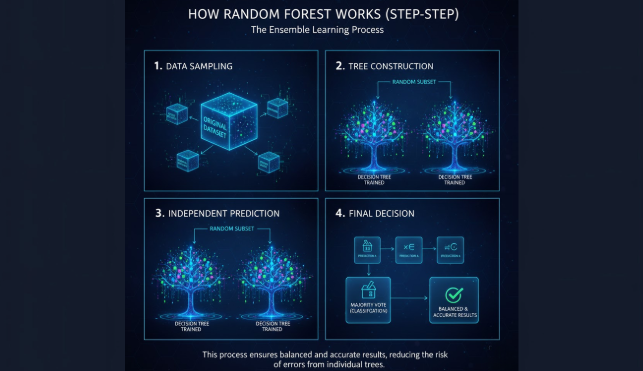
Artificial Intelligence needs strong algorithms to learn from data. Random Forest fits this role perfectly. Firstly, it is easy to train. Secondly, it works well with messy or missing data. Additionally, it shows which features matter most. Hence, data scientists love this clear and useful output.
Here are key reasons why AI and Random Forest make a great pair:
- Random Forest is fast to train on large datasets.
- Random Forest handles both numbers and categories with ease.
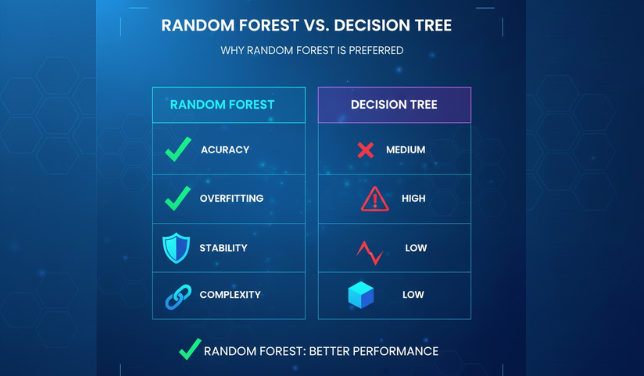
- It rarely overfits compared to single decision trees.
- It works without heavy tuning or deep math skills.
“In machine learning, simplicity often beats complexity — and Random Forest proves that every day.”
What a Random Forest Powers Real AI Applications
Many industries now depend on AI and Random Forest. For instance, hospitals use it to find early signs of cancer. Likewise, banks use it to spot fake transactions. Furthermore, e-commerce sites use it to suggest products. Even farmers use it to predict crop yields.
Read More: Google Colab: The Ultimate Guide for Beginners (2026)
| Industry | Use Case | Benefit |
|---|---|---|
| Healthcare | Disease prediction | Early diagnosis |
| Banking | Fraud detection | Lower financial loss |
| Retail | Product recommendation | Higher sales |
| Agriculture | Yield forecasting | Better planning |
| Marketing | Customer churn analysis | Stronger retention |
As you can see, AI and Random Forest touch nearly every field today. Moreover, they keep improving as data grows.
Read More: Discover the Best AI Models You Should Know in 2026
Random Forest vs Other AI Models
Many people ask how Random Forest compares with neural networks. Well, both have strengths. However, each fits different tasks. Neural networks shine with images, audio, and text. On the other hand, Random Forest wins on tabular data. Also, it needs less computing power.
| Feature | Random Forest | Neural Network |
|---|---|---|
| Training Speed | Fast | Slow |
| Best Data Type | Tabular | Images, Text |
| Setup Difficulty | Easy | Hard |
| Hardware Needs | Low | High (GPU) |
| Interpretability | High | Low |
“Use the right tool for the right job — Random Forest is often the smartest first choice.”
Therefore, when working with business data, AI and Random Forest are usually the best fit.
Benefits of Using AI and Random Forest
There are many reasons to choose this method. Below are the top benefits:
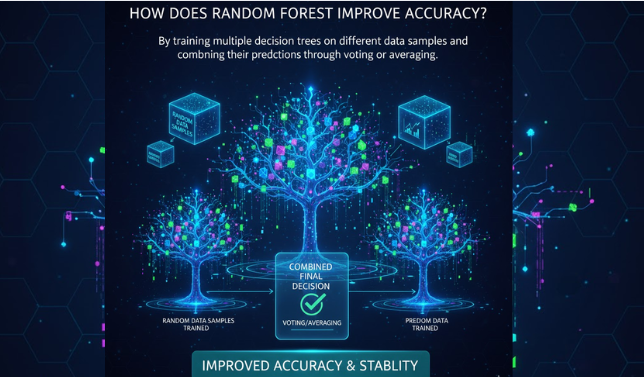
- High accuracy: Multiple trees reduce single-point errors.
- Less overfitting: Random sampling improves generalization.
- Easy to explain: Feature importance is built-in.
- Versatile: Works for classification and regression alike.
- Robust: Handles outliers and missing values smoothly.
In short, AI and Random Forest give strong results without too much effort.
Common Challenges and Smart Solutions
Of course, no tool is perfect. Sometimes, Random Forest models become large and slow. Also, they may struggle with very high-dimensional sparse data. However, smart steps can fix these issues. For example, you can limit tree depth. Likewise, you can reduce the number of trees. Moreover, modern tools now run AI and Random Forest on cloud platforms. Thus, speed is no longer a big worry.
Read More: Discover People Fast with Powerful Face Recognition Tool
“Every challenge in AI has a solution — you just need patience and the right tuning.”
Tips to Build a Strong Random Forest Model
If you want better results, follow these simple tips:
- Clean your data before training.
- Split data into train and test sets.
- Tune the number of trees carefully.
- Use cross-validation for honest scoring.
- Check feature importance to remove noise.
Consequently, your AI and Random Forest model will perform much better.
The Future of AI and Random Forest
The future looks bright for this duo. New tools now blend Random Forest with deep learning. Additionally, AutoML platforms make building models faster than ever. Soon, even non-coders will use AI and Random Forest with ease. Furthermore, edge devices will run these models in real time. Hence, smarter apps, cars, and homes are coming.
Read More: AI Trends 2026: Future of Artificial Intelligence Explained
Conclusion
To sum up, AI and Random Forest form one of the most useful pairs in machine learning. They are simple, strong, and flexible. Also, they fit many industries and tasks. Whether you are a student or a pro, this method is worth learning. So, start small, practice often, and grow your skills step by step.
Call to Action
Do you need quality content or better website rankings? I offer these expert services:
- Tech Article Writing
- On-Page SEO
- Keyword Research & Optimization
- Site Audit
📧 Email: zarirahc@gmail.com
📧 zarirahc@gmail.com
Looking to share your own expertise? We are accepting guest pitches! Check out our Write for Us page for guidelines.
Let’s work together to grow your brand with smart content and strong SEO.
FAQs
1. What is Random Forest in AI?
It is an algorithm that uses many decision trees to make accurate predictions.
2. Why is Random Forest popular in machine learning?
Because it is simple, fast, and gives strong results without much tuning.
3. Can beginners use AI and Random Forest?
Yes, it is one of the easiest models to learn and apply.
Read More: Ultimate Guide to K-Means Clustering Made Simple
4. What is the main benefit of Random Forest?
Moreover, it reduces overfitting and gives stable, reliable outputs.
5. Does Random Forest work for regression tasks?
Yes, it handles both regression and classification problems well.
6. How is Random Forest different from neural networks?
On the other hand, Random Forest is best for tabular data, while neural networks are more suitable for images and text.
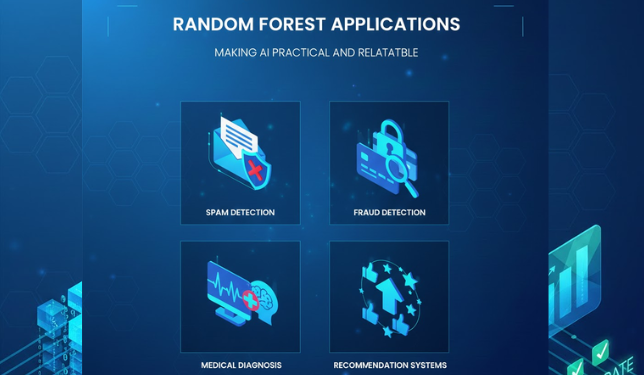
7. Which industries use AI and Random Forest the most?
For example, healthcare, banking, retail, agriculture, and marketing use it widely for predictions, analysis, and decision-making.
8. Is Random Forest slow on large datasets?
It can be, but cloud tools and tuning solve this issue.
Read More: TensorFlow vs PyTorch: Which Is Better for Beginners?
9. Can Random Forest handle missing data?
Yes, it manages missing or messy data better than many models.
10. What tools support Random Forest?
Additionally, popular tools include Scikit-learn, R, Apache Spark MLlib, and H2O.ai.
Author Bio
Zarirah Asif is a creative content writer who loves turning ideas into engaging words. She writes SEO-friendly articles that are easy to read and useful for readers. Her goal is to help brands stand out with quality content. She is always learning and improving her writing skills.













Post Comment
You must be logged in to post a comment.