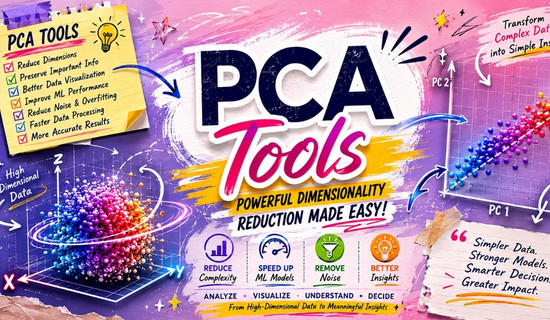
Best PCA Tools for Powerful Dimensionality Reduction in 2026
Introduction
Today, businesses generate more data than ever before. From online shopping and social media activity to customer transactions and IoT devices, data is growing at an incredible speed. As a result, organizations often struggle to manage and analyze large datasets effectively. This is where PCA Tools become incredibly valuable. By simplifying high-dimensional data and reducing unnecessary variables, PCA Tools help businesses process information more efficiently. Consequently, organizations can uncover meaningful insights faster and make better data-driven decisions.
This is where PCA Tools become extremely valuable. These tools help data scientists simplify complex datasets by reducing the number of variables while keeping the most important information intact.
However, working with high-dimensional data is not easy. When datasets contain hundreds or even thousands of features, machine learning models become slower and more difficult to train. In addition, unnecessary variables often introduce noise, making it harder to find useful insights.
Therefore, organizations use PCA Tools to reduce complexity and improve performance. By transforming large datasets into smaller and more meaningful representations, PCA helps analysts discover hidden patterns faster.
For example, companies like Google, Amazon, and Netflix process massive amounts of data every day. Without dimensionality reduction techniques such as PCA, analyzing this information efficiently would be much more difficult.
As a result, PCA has become one of the most important preprocessing techniques in modern data science and machine learning.
Read More: PCA in Python Made Easy: Basic and Easy Guide
What Are PCA Tools?
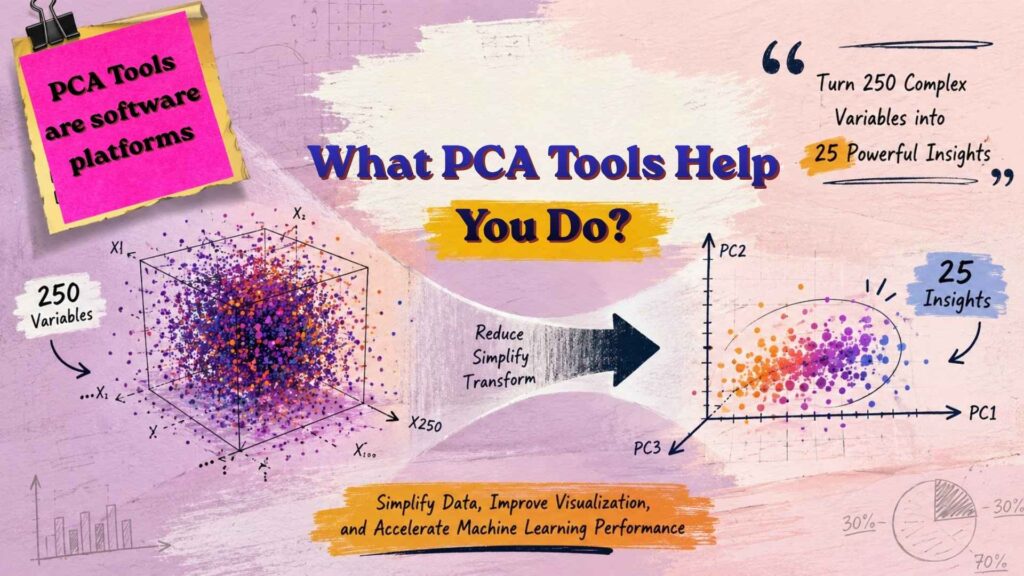
PCA Tools are software platforms, libraries, and analytical frameworks that automatically perform Principal Component Analysis (PCA).
Simply put, PCA is a statistical method that transforms a large group of related variables into a smaller set of independent variables known as principal components.
Instead of manually performing complex mathematical calculations, PCA tools automate the entire process.
As a result, data scientists can focus on analysis rather than mathematical computations.
What PCA Tools Help You Do?
| Function | Benefit |
|---|---|
| Reduce dimensions | Simplifies large datasets |
| Remove redundant features | Eliminates duplicate information |
| Improve visualization | Makes patterns easier to identify |
| Increase model speed | Reduces training time |
| Lower storage requirements | Uses less memory |
For example, imagine a customer dataset containing 250 variables.
Using PCA, you may reduce those variables to only 25 principal components while preserving over 90% of the original information.
Consequently, machine learning models become faster and more efficient.
Why PCA Tools Matter in Modern Data Science?
As organizations continue collecting larger datasets, dimensionality reduction becomes increasingly important.
Without PCA, many machine learning projects become slow, expensive, and difficult to manage.
Let’s examine why PCA Tools matter.
Read More: Principal Component Analysis: Learn It the Easy Way
Faster Computation
Large datasets require substantial computing power.
The more variables a dataset contains, the more calculations machine learning algorithms must perform.
Fortunately, PCA reduces the number of features before model training begins.
As a result:
- Training becomes faster
- Processing time decreases
- Memory consumption drops
- Hardware costs are reduced
For instance, Amazon analyzes millions of customer interactions daily. By reducing feature complexity, recommendation systems can process information much more efficiently.
Noise Reduction
Not every feature contributes useful information.
In fact, many variables simply add noise.
This noise can negatively impact machine learning performance.
However, PCA focuses on the most informative patterns in the data.
Therefore, less important variations are removed automatically.
As a result, predictive models often achieve better accuracy.
Better Data Visualization
Humans cannot easily understand datasets with hundreds of dimensions.
However, PCA Tools can reduce complex datasets into two or three dimensions.
Consequently, analysts can create meaningful visualizations.
For example:
| Original Dataset | After PCA |
|---|---|
| 200 Features | 2 Components |
| Difficult to Visualize | Easy Scatter Plot |
| Hidden Patterns | Clear Clusters |
Because of this, data exploration becomes much easier.
Improved Machine Learning Performance
Many machine learning algorithms suffer from the curse of dimensionality.
As the number of features increases, model performance may decline.
Therefore, PCA is often used before training begins.
Benefits include:
- Better generalization
- Reduced overfitting
- Faster training
- Simpler models
For example, Netflix uses dimensionality reduction techniques to analyze user preferences more efficiently.
Consequently, recommendation systems can deliver more accurate content suggestions.
Read More: Machine Learning: The Ultimate Guide for 2026
How PCA Tools Work
Although PCA is based on advanced mathematics, the overall idea is surprisingly simple.
Think of PCA as a smart data compression system.
Instead of storing every variable, PCA identifies the most valuable information and removes unnecessary complexity.
Let’s break the process into simple steps.

Step 1: Analyze Feature Relationships
First, PCA Tools examine relationships between variables.
The goal is to identify features that contain similar information.
For example:
| Feature | Related Feature |
|---|---|
| Customer Income | Spending Amount |
| Product Price | Discount Rate |
| Screen Size | Device Weight |
When variables are highly correlated, PCA recognizes this relationship.
As a result, redundancy can be reduced.
Read More:
Understanding Feature Relationships Through Correlation Analysis: A Guide for Data Enthusiasts
Step 2: Identify Principal Components
Next, PCA searches for directions that capture the maximum variation in the dataset.
These directions become principal components.
Each component summarizes information from multiple original variables.
Consequently, fewer variables are needed.
Step 3: Rank Components by Importance
After identifying components, PCA ranks them according to the amount of information they preserve.
The first component captures the most variance.
The second captures the next largest amount.
This process continues until all components are ranked.
Step 4: Remove Less Important Components
Finally, PCA removes components that contribute very little information.
As a result:
- Dataset size decreases
- Complexity drops
- Important patterns remain
Therefore, PCA acts as a highly efficient data compression technique.
Key Concepts Behind PCA Tools
To use PCA Tools effectively, it helps to understand a few core concepts.
Fortunately, these concepts are easier than they sound.
Eigenvalues
Eigenvalues measure how much information a principal component contains.
A larger eigenvalue means the component explains more variation in the data.
Example:
| Component | Eigenvalue |
|---|---|
| PC1 | 12 |
| PC2 | 4 |
| PC3 | 1 |
In this example, PC1 contains significantly more information than PC3.
Therefore, PC1 is more valuable.
Eigenvectors
Eigenvectors determine the direction of principal components.
They tell PCA where the strongest patterns exist within the data.
Although the mathematics can be complex, the practical purpose is simple.
They help identify the most informative feature combinations.
Explained Variance
Explained variance measures how much information each component preserves.
Consider the following example:
| Component | Explained Variance |
|---|---|
| PC1 | 50% |
| PC2 | 25% |
| PC3 | 15% |
| PC4 | 10% |
Notice that the first two components preserve 75% of the information.
Therefore, many analysts would keep only those two components.
As a result, dimensionality is reduced significantly while maintaining most of the valuable data.
Read More: Principal Component Analysis (PCA)
Comparison of the Top PCA Tools
Today, several PCA Tools are available for data scientists, researchers, and business analysts. However, each tool serves a slightly different purpose. While some tools focus heavily on machine learning, others emphasize visualization and statistical analysis. Therefore, choosing the right tool depends on your specific goals and requirements.
To make the selection process easier, the following comparison highlights some of the most popular PCA Tools available today.
Popular PCA Tools Comparison
| PCA Tool | Environment | Ease of Use | Visualization | Best For |
|---|---|---|---|---|
| Scikit-learn | Python | High | Moderate | Machine Learning Projects |
| FactoMineR | R | High | Excellent | Statistical Analysis |
| MATLAB Statistics Toolbox | MATLAB | Moderate | Strong | Engineering Applications |
| Orange Data Mining | Visual Interface | Very High | Excellent | Beginners |
| KNIME | Workflow Platform | High | Strong | Business Analytics |
| Tableau | Business Intelligence | High | Excellent | Data Visualization |
As you can see, different PCA Tools are designed for different purposes. For example, some prioritize automation and machine learning, whereas others focus on reporting and visualization. Consequently, understanding these differences can help you select the most suitable solution.
Now, let’s explore some of the most popular PCA Tools in greater detail.

Scikit-learn: The Most Popular PCA Tool for Machine Learning
When people discuss PCA Tools, Scikit-learn is often the first solution that comes to mind. In fact, it is one of the most widely used machine learning libraries in Python.
Because of its simplicity and flexibility, it has become a preferred choice for both beginners and experienced professionals. Moreover, its PCA implementation is straightforward and highly efficient. As a result, users can quickly reduce dimensions without dealing with unnecessary complexitR.
Read More: Affordable to Pro: Best Laptops for Ethical Hacking That Actually Work
Why Data Scientists Love Scikit-learn
- Easy implementation
- Excellent documentation
- Strong community support
- Fast processing
- Seamless machine learning integration
For example, Google data scientists often rely on Python-based workflows to process massive datasets. Likewise, startups and large enterprises frequently build PCA pipelines using Scikit-learn because it saves both time and computational resources. Furthermore, it integrates smoothly with other machine learning algorithms, making model development much easier.
Benefits of PCA Tools
As datasets continue to expand, organizations need smarter ways to process information. Fortunately, PCA Tools help solve this challenge. By reducing the number of variables, they make data easier to analyze. As a result, machine learning workflows become faster and more efficient.
Moreover, PCA helps data scientists focus on the most important information while removing unnecessary complexity. Consequently, businesses can uncover insights more quickly and make better decisions.
Faster Machine Learning Workflows
One of the biggest advantages of PCA Tools is improved computational efficiency. When datasets contain hundreds or even thousands of features, machine learning models require more processing power. Therefore, training can become slow and expensive.
However, PCA reduces the number of variables before model training begins. As a result, algorithms process data much faster. Additionally, memory usage decreases, which further improves performance.
For example, Amazon analyzes billions of customer interactions every year. Because recommendation systems handle enormous datasets, dimensionality reduction becomes essential. Consequently, Amazon can process information more efficiently and deliver recommendations faster.
Similarly, financial institutions use PCA to simplify large risk-analysis datasets. Therefore, analysts can evaluate information more quickly and accurately.
Better Data Visualization
Another major advantage of PCA Tools is improved visualization. Unfortunately, humans cannot easily interpret datasets with hundreds of dimensions. Therefore, identifying patterns becomes difficult.
Fortunately, PCA reduces complex datasets into two or three principal components. As a result, analysts can create meaningful visualizations that reveal hidden insights.
For instance, marketing teams often use PCA to identify customer segments. Consequently, businesses can create more targeted campaigns. Likewise, healthcare researchers use PCA to detect patterns in patient data. As a result, critical insights become easier to discover.
Noise Reduction and Better Accuracy
Not every feature contributes meaningful information. In fact, many variables introduce noise that can negatively impact model performance.
Fortunately, PCA Tools focus on the directions that contain the most important variation. Consequently, less useful information is reduced. As a result, predictive models often become more accurate.
Furthermore, cleaner datasets help machine learning algorithms learn meaningful patterns. Therefore, model performance frequently improves.
Read More: Advantages & Disadvantages of Principal Component Analysis (PCA)

Reduced Overfitting
In addition to improving efficiency, PCA can also reduce overfitting. Overfitting occurs when a model learns unnecessary details instead of meaningful patterns. Consequently, it performs poorly on new data.
However, PCA removes redundant variables and simplifies the feature space. As a result, models become more generalized and reliable.
Therefore, many data scientists include PCA as a standard preprocessing step in machine learning pipelines.
Limitations of PCA Tools
Although PCA Tools offer many benefits, they also have limitations. Therefore, it is important to understand these challenges before implementation.
Information Loss
Perhaps the most significant limitation is information loss. Whenever dimensions are removed, some information is inevitably discarded.
Although PCA preserves the most important patterns, smaller details may disappear. Consequently, excessive dimensionality reduction can negatively affect performance.
Therefore, analysts should carefully evaluate explained variance before removing components.
Reduced Interpretability
Another challenge involves interpretability. Original features such as age, income, and purchase frequency are usually easy to understand.
However, principal components combine multiple variables into new dimensions. As a result, explaining those components becomes more difficult.
Therefore, while PCA simplifies data mathematically, it can make business interpretation more complex.
Assumption of Linear Relationships
Additionally, traditional PCA assumes that relationships between variables are linear. However, many real-world datasets contain nonlinear relationships.
For example, customer behavior, financial markets, and biological systems often involve complex interactions. Consequently, PCA may not capture every important pattern.
In such situations, alternative dimensionality reduction methods may perform better.
Read More: Machine learning
Sensitivity to Feature Scaling
Finally, PCA is highly sensitive to feature scaling. If variables have different ranges, features with larger values can dominate the analysis.
For example, income values are often much larger than age values. Therefore, income may heavily influence the resulting components.
Consequently, standardizing data before applying PCA is essential. Otherwise, the results may be misleading.
Call To Action
Need SEO content that ranks on Google and keeps readers engaged?
I create:
- SEO blog posts
- Keyword-focused articles
- Human-style content
- Easy-to-read blogs
- High-engagement website content
Let’s build content that performs.
📧 Email: craziya167@gmail.com
Author Bio:
Digital Raziya is an SEO content writer who specializes in AI, technology, and digital marketing topics. Her goal is to create clear, engaging, and easy-to-understand content for online readers.














Post Comment
You must be logged in to post a comment.