PCA in Python Made Easy: Basic and Easy Guide

Today, data is everywhere.
Because of this, understanding data has become important.
That is exactly where PCA in Python becomes useful.
In modern AI systems, data must be simple.
Otherwise, even advanced models struggle.
For that reason, PCA plays a key role.
This article explains everything step by step.
At the same time, language stays very easy.
Most importantly, learning stays stress-free.
By the end, PCA in Python will feel clear.
In addition, its role in AI will feel exciting.
So, let’s begin.
What Is PCA in Simple Words?
PCA stands for Principal Component Analysis.
In simple terms, it reduces data size.
However, meaning is still preserved.

Instead of many features, PCA creates fewer ones.
These new features are more powerful.
They capture the strongest patterns.
As a result, data becomes easier to handle.
Because of that, analysis becomes faster.
Therefore, PCA is widely used.
Why PCA in Python Matters Today
Nowadays, datasets are very large.
Because of this, processing becomes slow.
That is why PCA in Python is important.
AI models perform better with fewer features.
As a result, accuracy improves.
Meanwhile, training time decreases.
In addition, memory usage becomes lower.
This matters a lot in real AI systems.
Therefore, PCA supports efficiency.
Connection Between PCA and Artificial Intelligence
Artificial Intelligence depends on data quality.
However, raw data is often noisy.
This is where PCA helps.
PCA removes unnecessary variation.
Because of this, AI models focus better.
Consequently, predictions improve.
In many AI pipelines, PCA is used early.
After that, models learn faster.
Thus, PCA supports intelligent systems.
PCA as an Unsupervised Learning Technique
PCA belongs to unsupervised learning.
That means no labels are required.
Patterns are discovered automatically.
Unlike supervised learning, answers are not provided.
Instead, structure is explored.
This makes PCA powerful.
Many AI tasks start this way.
Therefore, PCA becomes very useful.
Insights appear quickly.
Short History of Learning Methods

Machine learning evolved over time.
At first, systems used fixed rules.
Later, supervised learning became popular.
As data increased, labeling became difficult.
Because of that, unsupervised methods gained value.
PCA became a strong solution.
Today, AI depends on this shift.
Large data needs smart reduction.
PCA solves that problem.
Read more: Best PCA Tools for Powerful Dimensionality Reduction in 2026
Learning Evolution Overview
| Time Period | Learning Style | Main Purpose |
|---|---|---|
| Early years | Rule-based systems | Manual decisions |
| 1980s | Supervised learning | Prediction |
| 1990s | Statistical learning | Pattern discovery |
| 2000s | Unsupervised learning | Data structure |
| Today | AI with PCA | Smart simplification |
This journey explains PCA’s importance.
How PCA Works in an Easy Way
First, PCA looks at data variation.
Then, it finds the strongest directions.
These directions become components.
The first component holds most information.
The second holds slightly less.
Others follow in order.
Finally, weak details are removed.
Strong patterns remain.
That is how PCA works.
How PCA in Python Is Used Conceptually
Python makes PCA easy to apply.
However, understanding the idea matters more.
The process follows simple logic.
First, data is prepared carefully.
Next, PCA is applied.
Afterward, results are checked.
Behind the scenes, PCA in Python automates everything.
Still, the concept stays simple.
That helps beginners a lot.
Understanding PCA Results Clearly
PCA produces clear results.
One result shows information retention.
Another shows transformed data.
Higher retention means better representation.
Lower retention means caution is needed.
Therefore, balance is important.
This step builds confidence.
It also prevents wrong conclusions.
Careful review always helps.
PCA with Three Components Explained
Sometimes, one or two components are not enough.
In those cases, three components are useful.
This approach captures more structure.
With three components, clarity improves.
At the same time, simplicity remains.
That balance works well.
Many AI tasks benefit from this.
Especially clustering problems.
Patterns become easier to see.
Visual Power of PCA
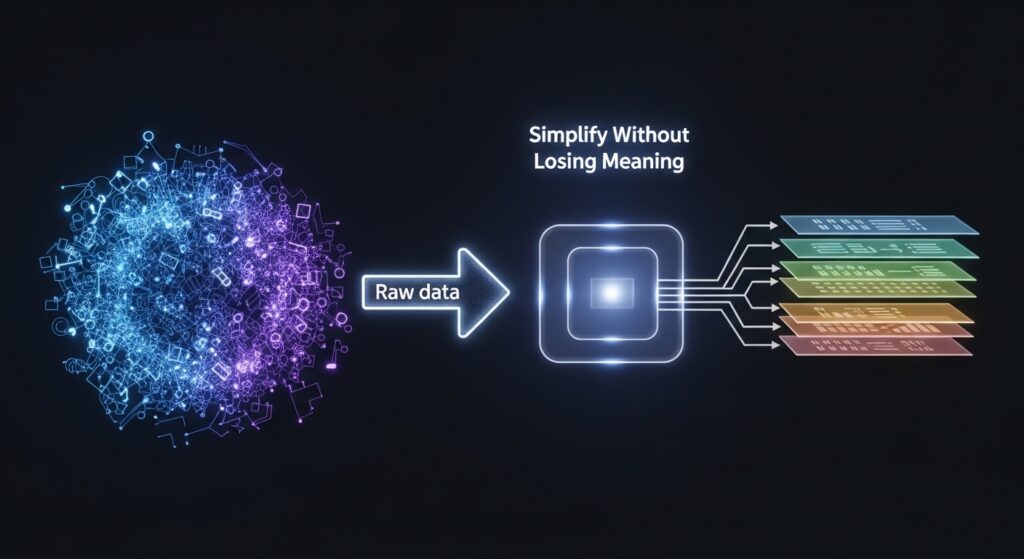
Before PCA, data looks crowded.
After PCA, structure appears.
This change feels impressive.
Clusters stand out clearly.
Trends become visible.
Hidden insights emerge.
Because of this, PCA improves understanding.
It also makes learning enjoyable.
Visual clarity matters.
When Should You Use PCA in Python?
PCA is helpful in many situations.
However, it is not always required.
Knowing when to use it is important.
Use PCA when:
- Data has many features
- Features are correlated
- AI models are slow
- Visualization is needed
Otherwise, simple data may not need PCA.
Smart choices improve results.
Read more: Python Tutorial: A Simple and Beginner-Friendly Guide 2026
Key Benefits of PCA in Python
PCA reduces complexity.
As a result, speed increases.
AI models train faster.
Memory usage becomes lower.
Noise is reduced.
Generalization improves.
Because of these benefits, PCA is popular.
Efficiency is critical in AI.
PCA supports that goal.
Limitations You Should Know
PCA is not perfect.
Interpretation becomes harder.
Original features change.
Also, PCA assumes linear patterns.
Nonlinear data may not work well.
Therefore, awareness is important.
Balanced understanding prevents misuse.
Tools must be used wisely.
Knowledge brings control.
PCA vs Feature Selection Explained Simply
Feature selection keeps original features.
PCA creates new features.
Both reduce data size.
However, PCA focuses on variance.
Feature selection focuses on relevance.
Goals are different.
The problem decides the method.
Flexibility is necessary.
No single approach fits all.
Common Beginner Mistakes
Many beginners skip data preparation.
Others choose too many components.
Some ignore result analysis.
These mistakes reduce PCA value.
Thankfully, they are easy to fix.
Learning solves most problems.
Practice builds confidence.
Experience builds skill.
Progress follows naturally
Smart Tip for AI Projects
Think of PCA as AI preparation.
It clears the path for learning.
Strong input creates strong output.
This mindset improves results.
It also saves resources.
Efficiency always wins.
Eye-Catching Analogy for PCA
Imagine AI wearing focus glasses.
Noise disappears.
Important signals stay clear.
PCA provides those glasses.
AI sees better.
Decisions improve.
This idea stays memorable.
Learning feels easier.
Understanding lasts longer.
Real-World Uses of PCA in Python

PCA helps in facial recognition.
It improves recommendation systems.
It supports medical data analysis.
Finance uses PCA for risk analysis.
Marketing uses it for customer insights.
AI uses PCA everywhere.
Its impact is significant.
FAQs About PCA in Python
What is PCA in Python?
PCA in Python reduces data size.
Important information stays intact.
How does PCA help AI?
PCA prepares clean data.
AI models become faster and more accurate.
Is PCA supervised learning?
No, PCA is unsupervised.
Labels are not needed.
How many components should be used?
Enough components keep most information.
Usually, 90–95% is ideal.
Is PCA suitable for beginners?
Yes, PCA is beginner-friendly.
Conceptual understanding is enough.
Final Thoughts
PCA does not have to feel difficult.
With simple explanation, it becomes friendly.
AI makes it even more valuable.
Now, PCA in Python should feel understandable.
More importantly, it should feel useful.
This knowledge helps you move forward 🚀
Call To Action:
Want SEO-optimized content that ranks higher and attracts the right audience?
I help websites grow with keyword-focused, easy-to-read blog posts and strong on-page SEO strategies.
Get in touch today and let’s grow your content the smart way.
📧 Email: craziya167@gmail.com
📞 Phone / WhatsApp: +92 03110115488













Post Comment
You must be logged in to post a comment.