Feature Engineering with AI: Smarter Data, Better Models

In modern data science, raw data alone is not enough.
Instead, meaningful features determine model success.
For this reason, feature engineering with AI plays a vital role.
However, traditional feature engineering takes time.
Moreover, manual processes often introduce bias.
As a result, many teams struggle with efficiency.
Thankfully, Feature Engineering with AI is transforming this process.
Today, artificial intelligence automates complex feature creation.
Consequently, machine learning models become faster and smarter.
In this guide, AI-driven feature engineering is explained clearly.
Additionally, benefits, techniques, tools, and best practices are covered.
By the end, the importance of AI will be obvious.
What Is Feature Engineering?
Simply stated, feature engineering transforms raw data.
These transformations help models detect patterns.
For example, dates turn into time-based features.
Likewise, text becomes numerical vectors.
Meanwhile, raw values get scaled for consistency.
Traditionally, humans design these features.
However, this approach requires strong domain expertise.
Furthermore, it consumes a lot of development time.
That is why Feature Engineering with AI is essential today.
Why Feature Engineering Is So Important
Machine learning models depend on features.
Without them, even advanced algorithms fail.
In contrast, high-quality features improve predictions.
As a result, accuracy increases significantly.
Additionally, strong features reduce overfitting.
Consequently, models perform better on new data.
Most importantly, feature engineering drives business impact.
Therefore, AI-based automation becomes a game changer.
What Is Feature Engineering with AI?
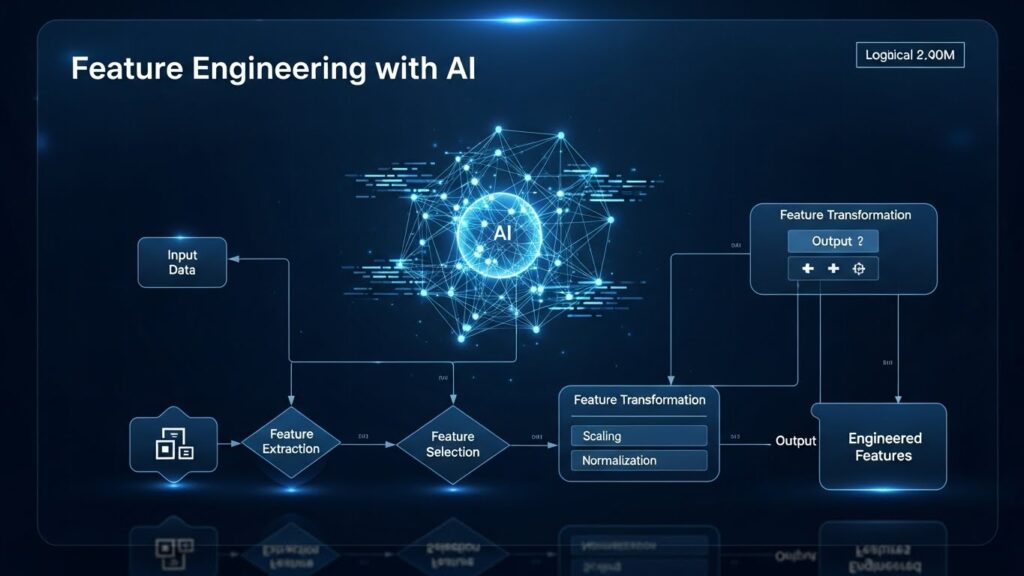
Feature Engineering with AI uses intelligent algorithms.
These systems create and optimize features automatically.
Instead of manual work, AI learns transformations.
For instance, hidden patterns are detected in data.
Then, meaningful features are generated.
Unlike traditional methods, AI adapts continuously.
As data changes, features evolve automatically.
Because of this flexibility, AI-powered methods outperform manual ones.
How AI Automates Feature Engineering
AI uses multiple techniques to engineer features.
Each technique serves a specific purpose.
Below are the most effective approaches.
Automated Feature Extraction
First, AI extracts features directly from raw data.
This approach works well for images and text.
For example, deep learning finds visual patterns.
Meanwhile, NLP models understand text meaning.
As a result, manual preprocessing becomes unnecessary.
Feature Transformation with AI
Next, AI transforms existing features intelligently.
Scaling and encoding happen automatically.
Furthermore, AI selects the best transformation method.
This decision depends on data distribution.
Consequently, overall data quality improves.
Feature Selection Using AI
Not every feature is useful.
Some features create noise.
AI identifies irrelevant variables quickly.
Then, unnecessary features are removed.
Because of this pruning, training becomes faster.
Additionally, model interpretability improves.
Feature Generation Through AI
AI can also generate new features.
These features combine existing variables.
For example, ratios and interactions appear automatically.
As a result, deeper insights are uncovered.
This ability defines advanced Feature Engineering with AI.
Benefits of Feature Engineering with AI
AI-driven feature engineering provides many advantages.
Each benefit improves performance and scalability.
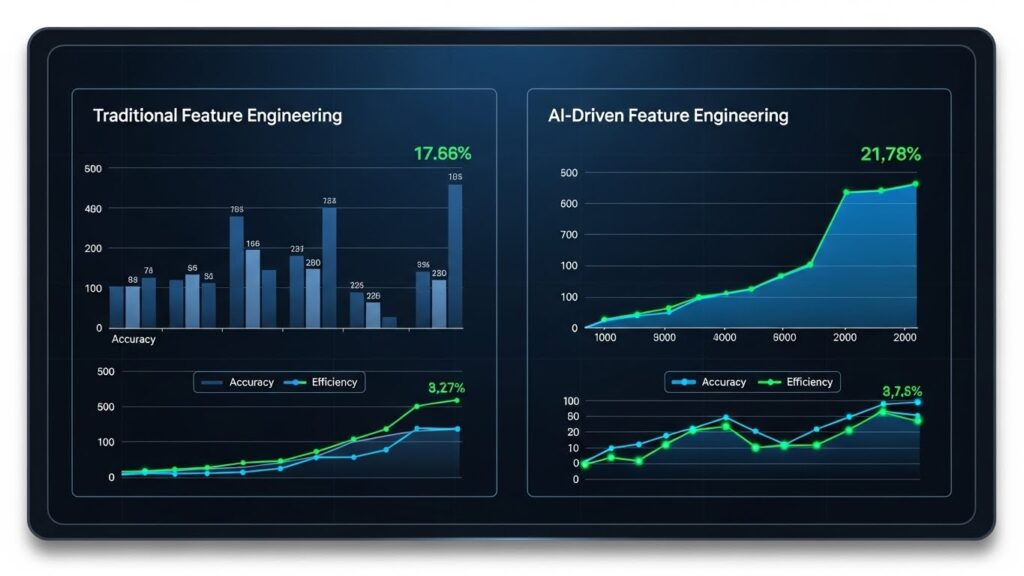
Faster Model Development
Manual feature creation takes weeks.
In contrast, AI completes tasks quickly.
Therefore, teams deliver models faster.
As a result, innovation accelerates.
Higher Accuracy
AI discovers complex relationships in data.
Humans often miss these patterns.
Consequently, AI-trained models perform better.
Accuracy improves across datasets.
Reduced Human Bias
Human decisions can introduce bias.
AI focuses on data-driven patterns.
Because of this, outcomes become more objective.
Fairness improves in sensitive use cases.
Scalability Across Projects
Manual processes do not scale well.
AI handles large datasets easily.
Thus, feature pipelines are reused efficiently.
Productivity increases across teams.
Feature Engineering with AI in Real-World Use Cases
Today, AI-driven feature engineering is widely adopted.
Many industries benefit from this approach.
Finance and Banking
In finance, risk prediction is essential.
AI generates transactional and behavioral features.
As a result, fraud detection improves.
Credit scoring also becomes more accurate.
Healthcare Analytics
Medical data is complex and sensitive.
AI extracts meaningful signals from records.
Therefore, diagnostic models become reliable.
Personalized treatments also improve.
E-Commerce and Marketing
Customer behavior generates massive data.
AI engineers features from clicks and purchases.
Consequently, recommendation systems perform better.
Customer retention also increases.
Manufacturing and IoT
Sensor data streams continuously.
AI creates time-based features automatically.
Thus, predictive maintenance becomes possible.
Downtime reduces significantly.
Popular Tools for Feature Engineering with AI
Several tools simplify AI-based feature engineering.
Each option offers unique strengths.

AutoML Platforms
AutoML tools automate complete workflows.
Feature engineering is included by default.
Many platforms are cloud-based.
Both beginners and experts benefit.
Feature Stores
Feature stores manage reusable features.
AI pipelines integrate smoothly.
As a result, consistency improves.
Team collaboration becomes easier.
Python Libraries
Python provides powerful libraries.
These tools support automated feature creation.
Therefore, developers maintain flexibility.
Customization remains possible.
Best Practices for Feature Engineering with AI
Although AI automates work, best practices still matter.
Following guidelines ensures reliable results.
Understand the Data First
AI performs best with clean data.
Understanding data sources is critical.
Thus, always validate data quality.
Fix errors early.
Combine Domain Knowledge with AI
AI is powerful but imperfect.
Human insight adds valuable context.
Therefore, combine expertise with automation.
Results become more meaningful.
Monitor Feature Drift
Data changes over time.
Features may lose relevance.
AI systems must detect drift.
Regular retraining maintains accuracy.
Keep Interpretability in Mind
Complex features reduce transparency.
Trust depends on understanding.
Thus, balance performance and explainability.
Stakeholders value clarity.
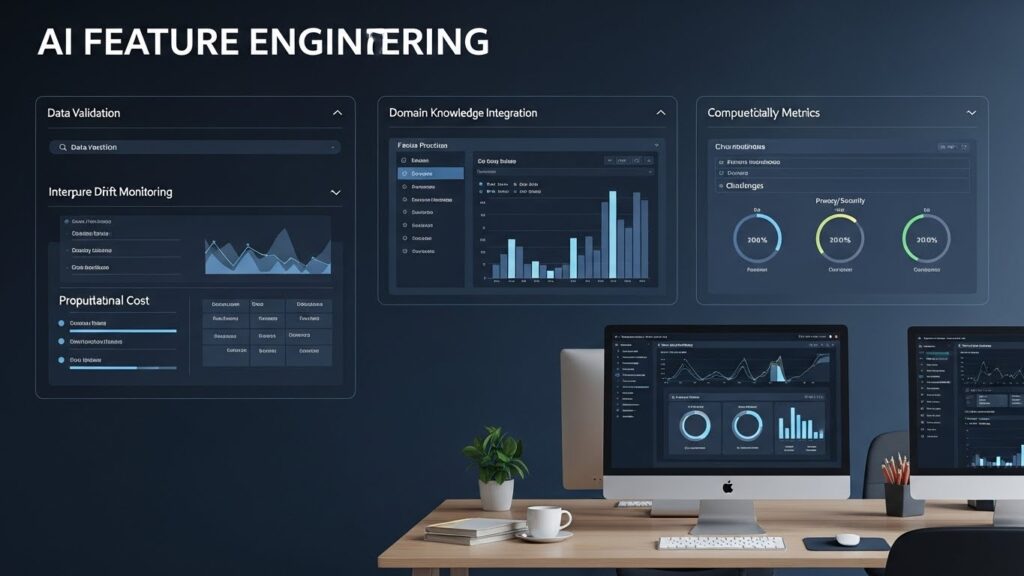
Challenges of Feature Engineering with AI
Despite benefits, challenges remain.
Awareness helps reduce risks.
Computational Costs
AI processing requires resources.
Large datasets increase costs.
Therefore, efficient infrastructure is necessary.
Optimization helps control expenses.
Over-Automation Risks
Blind automation can create useless features.
Quality checks remain important.
As a result, human review is essential.
Balance automation with oversight.
Data Privacy Concerns
Sensitive data needs protection.
AI pipelines must follow regulations.
Hence, privacy-preserving methods are vital.
Security should never be ignored.
The Future of Feature Engineering with AI
Feature engineering continues to evolve.
AI will dominate future workflows.
Real-time adaptation will become standard.
Self-learning pipelines will expand.
Moreover, explainable AI will improve trust.
Transparency will increase adoption.
Ultimately, Feature Engineering with AI will become the norm.
Manual methods will fade away.
Frequently Asked Questions (FAQs)
What is Feature Engineering with AI?
Simply put, Feature Engineering with AI uses artificial intelligence to create features from raw data.
As a result, machine learning models learn patterns more effectively.
Why is feature engineering important in machine learning?
First of all, models depend heavily on features.
Therefore, strong feature engineering improves accuracy and reliability.
How does AI improve feature engineering?
In many cases, AI detects hidden data patterns.
Because of this, features become more meaningful and powerful.
Is Feature Engineering with AI better than manual feature engineering?
Generally speaking, AI-based methods perform better.
However, combining AI with human expertise produces the best outcomes.
Can beginners use Feature Engineering with AI?
Fortunately, beginners can use it easily.
For example, many AutoML tools require little or no coding.
Which industries use Feature Engineering with AI?
Currently, many industries rely on this approach.
For instance, finance, healthcare, and e-commerce benefit greatly.
Does Feature Engineering with AI increase model accuracy?
In most situations, accuracy improves significantly.
As a consequence, predictions become more reliable.
Are there any risks in Feature Engineering with AI?
Although benefits are strong, some risks exist.
For this reason, monitoring and data validation remain important.
Final Thoughts
Feature engineering defines model success.
AI transforms this process completely.
Through automation, efficiency rises.
Accuracy improves consistently.
Most importantly, innovation accelerates.
Businesses gain a competitive edge.
If better models matter to you, act now.
Adopt Feature Engineering with AI today 🚀
Call to Action: Let’s Grow Your Website the Smart Way
If you want your content to rank higher and convert better, you need the right strategy.
That is exactly where I can help.
With strong expertise in keyword research, I find search terms that people actually use.
As a result, your content targets the right audience from the start.
In addition, my content writing focuses on clarity, structure, and engagement.
Therefore, readers stay longer and trust your brand more.
Moreover, I specialize in on-page SEO optimization.
This means your content is optimized for search engines and users at the same time.
From proper headings to keyword placement, everything is handled carefully.
Consequently, your website gains visibility and authority.
Whether you need a full SEO-optimized article or keyword-focused content planning, I am ready.
Likewise, if you want to improve existing content, I can do that too.
So, if you are serious about growth, take the next step today.
Reach out and let’s turn your content into real results.
📧 Email: craziya167@gmail.com
Let’s work together and build content that ranks, converts, and lasts 🚀













Post Comment
You must be logged in to post a comment.