Machine Learning for Beginners: A Practical Guide (2026)

Machine Learning is one of the fastest-growing technologies in the world today.
In fact, it is already part of our daily life.
For example, social media feeds, online shopping, navigation apps, and smart assistants all use Machine Learn field. Even though we don’t see it, it works silently in the background.
If you are new and searching for a machine learning for beginners' step-by-step tutorial, this guide is made just for you.
Most importantly, you do not need advanced math or deep programming skills to start.
In this article, everything is explained clearly, simply, and practically.
What Is Machine Learning? (Simple Definition)
It (ML) is a part of Artificial Intelligence (AI).
It allows computers to learn from data and improve over time without being directly programmed.
Instead of writing rules for every situation, we give machines:
- Data
- Examples
- Feedback
As a result, the system learns patterns and makes predictions by itself.
Simple Example
When YouTube recommends videos based on what you watch, like, or skip, it is using machine learning algorithms.
In other words, the system learns your preferences from data.

Why Machine learning Is Important in 2026
Today, it (ML) is no longer limited to big tech companies.
Instead, it is used in almost every industry.
Key reasons ML is important:
- It automates complex tasks
- It saves time and money
- It improves decision-making
- It powers modern AI tools
- It creates new career opportunities
Because of this, ML skills are becoming more valuable every year.
Industries using machine learning:
- Healthcare
- Education
- Finance
- E-commerce
- Marketing
- Cybersecurity
How Machine Learning Works (Step by Step)
To understand it (ML), it helps to break the process into simple steps.
Step 1: Data Collection
First of all, machine learning starts with data.
In simple terms, data is the foundation of every ML system.
This data can include:
- Numbers (prices, scores, sales)
- Text (emails, reviews)
- Images (photos, scans)
- Audio or video
For example, student exam scores can be used to predict future performance.
Step 2: Data Preparation
However, raw data is often messy and incomplete.
Therefore, it must be cleaned before being used.
This step usually includes:
- Removing duplicate data
- Fixing errors
- Handling missing values
- Converting text into numbers
As a result, the data becomes more accurate and useful.
This process is called data preprocessing, and it is one of the most important steps in machine learning.
Step 3: Choosing a Machine Learning Algorithm
Next, we select a suitable machine learning algorithm.
Simply put, an algorithm is a method that helps the system learn from data.
Beginner-friendly algorithms include:
- Linear Regression
- Logistic Regression
- Decision Trees
- K-Nearest Neighbors
In practice, each algorithm is designed to solve a specific type of problem.
Step 4: Training the Model
After that, the model is trained using prepared data.
During this stage, the system learns patterns and reduces errors.
Generally, higher-quality data leads to better results.
Step 5: Testing and Improving
Finally, the trained model is tested using new data.
Importantly, this data was not used during training.
If the results are not accurate, we can:
- Improve the data
- Choose a different algorithm
- Adjust model settings
In this way, the model continues to improve over time.

Types of Machine Learning (Explained Simply)
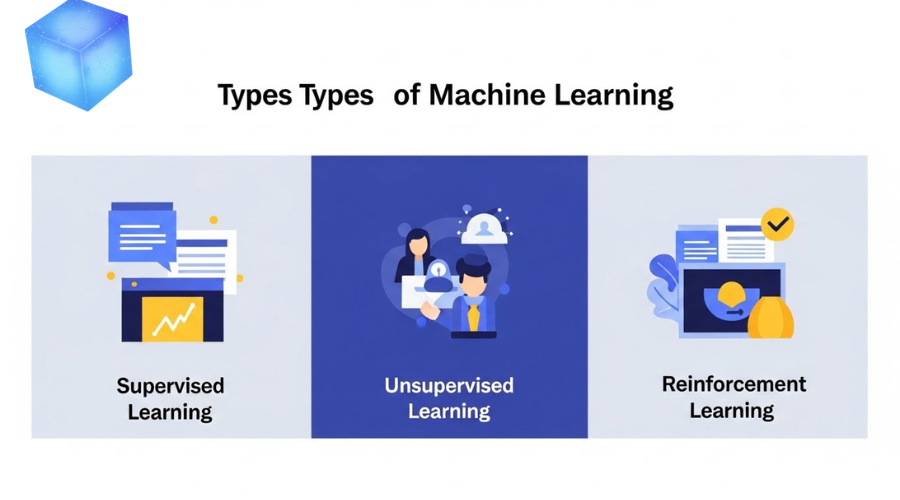
There are three main types of (ML).
1. Supervised Learning
In, Supervise learning the data already has correct answers.
Examples:
- Email spam detection
- House price prediction
- Exam result prediction
Common algorithms:
- Linear Regression
- Logistic Regression
- Random Forest
2. Unsupervised Learning
In Unsupervised Learning the data has no labels.
So, the model finds patterns on its own.
Examples:
- Customer segmentation
- Grouping similar products
- Market analysis
Common techniques:
- Clustering
- K-Means
3. Reinforcement Learning
In, Reinforcement Learning the model learns through trial and error.
It receives rewards for correct actions.
Examples:
- Game-playing AI
- Robotics
- Self-driving cars (basic idea)
Real-Life Applications of (ML):
Every day, you use machine learning without realizing it.
Some common examples include:
- Google Search ranking
- Netflix and YouTube recommendations
- Face unlocks on smartphones
- Voice assistants like Siri
- Online shopping suggestions
- Fraud detection in banking
Over time, these systems improve as more data is collected.
Do You Need Coding to Learn (ML)?
Short answer: No, not at the beginning
At first, you can focus on:
- Understanding basic concepts
- Learning how algorithms work
- Using no-code or low-code tools
- Studying real-life examples
When Coding Becomes Useful
Later, coding helps you:
- Build your own models
- Work with real datasets
- Improve accuracy
The most popular language for ML is Python.
This is because it is simple and has powerful libraries.
Essential Machine Learning Tools for Beginners
Here are some tools that beginners should know.
Google Colab
- Free online Python notebooks
- No installation needed
- Runs in the browser
Kaggle
- Free datasets
- Practice notebooks
- Learning competitions
Scikit-learn
- Easy ML library
- Perfect for beginners
Online Learning Platforms
- Coursera
- Free ML tutorials
- University-level courses
Machine Learning Roadmap for Beginners (2025)
To learn effectively, follow this simple path:
- Learn AI and ML basics
- Understand data concepts
- Study very basic statistics
- Learn Python fundamentals
- Practice simple ML models
- Build small projects
- Explore advanced topics slowly
Above all, consistency matters more than speed.

Common Machine Learning Myths
Myth 1: It (ML) is only for geniuses
Reality: Anyone can learn it step by step.
Myth 2: You must be good at math
Reality: Basic understanding is enough at first.
Myth 3: Machine learning will replace all jobs
Reality: ML creates new jobs and improves old ones.
Career Opportunities in Machine Learning
Machine Learning Opens many career paths, such as:
- Machine Learning Engineer
- Data Scientist
- AI Analyst
- Research Assistant
- ML Product Specialist
Even non-technical roles benefit from ML knowledge.
FAQs – Machine Learning for Beginners
Is machine learning difficult for beginners?
No. With a simple and structured approach, it becomes easier.
How long does it take to learn machine learning?
- Basics: 2–3 months
- Practical skills: 6–12 months
Is ML a good career in 2025?
Yes. Demand is growing worldwide.
Call to Action: Let’s Grow Your Website the Smart Way
If you want your content to rank higher and convert better, you need the right strategy.
That is exactly where I can help.
With strong expertise in keyword research, I find search terms that people actually use.
As a result, your content targets the right audience from the start.
In addition, my content writing focuses on clarity, structure, and engagement.
Therefore, readers stay longer and trust your brand more.
Moreover, I specialize in on-page SEO optimization.
This means your content is optimized for search engines and users at the same time.
From proper headings to keyword placement, everything is handled carefully.
Consequently, your website gains visibility and authority.
Whether you need a full SEO-optimized article or keyword-focused content planning, I am ready.
Likewise, if you want to improve existing content, I can do that too.
So, if you are serious about growth, take the next step today.
Reach out and let’s turn your content into real results.
📧 Email: craziya167@gmail.com
Let’s work together and build content that ranks, converts, and lasts 🚀
Final Thoughts
At first, machine learning may seem complex.
However, when you start with the basics, it quickly becomes easier to understand.
For this reason, focus on simple concepts first.
Then, practice regularly and learn step by step.
Over time, with patience and consistency, machine learning can become a powerful skill for your future.













Post Comment
You must be logged in to post a comment.