
Principal Component Analysis: Learn It the Easy Way
Data is everywhere today.
However, understanding it still feels difficult.
Therefore, smarter techniques are needed.
One powerful method is principal component analysis.
In simple words, principal component analysis makes complex data easier to understand.
As a result, learning becomes faster and more effective.
Many beginners fear PCA.
Yet, this fear is unnecessary.
In reality, PCA is logical.
Moreover, it is practical.
Because of this, experts use it daily.
Now, let us learn PCA the easy way.
What Is Principal Component Analysis?
Principal Component Analysis is a data reduction method.
Simply stated, it reduces complexity.
Instead of many features, it keeps important ones.
Thus, analysis becomes simpler.
Usually, datasets contain noise.
Because of that, models perform poorly.
PCA removes this noise.
Consequently, patterns become visible.
Importantly, PCA does not destroy information.
Instead, it preserves the most useful parts.
So, results stay reliable.
Why Principal Component Analysis Is Important
Modern datasets are very large.
Therefore, handling them is expensive.
Training time increases rapidly.
Meanwhile, memory usage grows.
PCA solves these problems.
First, it reduces dimensions.
Next, it improves performance.
Afterward, systems become efficient.
Most importantly, insights become clearer.
Thus, decisions improve.
Read more: Best Data Mining Tools for Big Data & Analytics
Principal Component Analysis with AI
Artificial Intelligence depends on clean data.
However, raw data is often messy.
Because of this, preprocessing is critical.
Here, Principal Component Analysis with AI plays a major role.
PCA prepares data for machine learning.
As a result, AI models learn better.
For example, image recognition uses PCA.
Similarly, speech systems benefit from it.
Even recommendation engines apply PCA.
Therefore, PCA strengthens AI systems.
How PCA Works in Simple Language
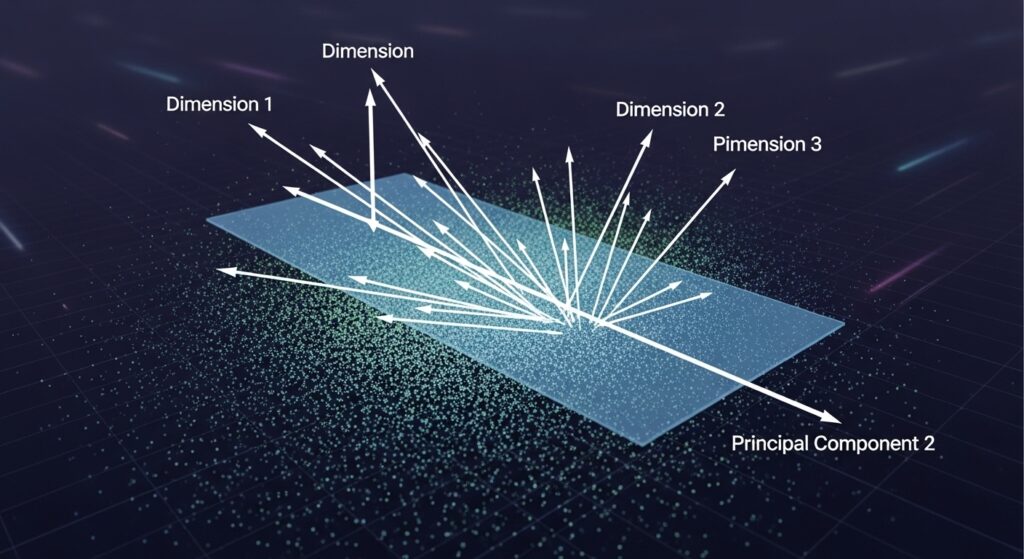
First, PCA studies data variance.
Variance means how data spreads.
Higher spread means more information.
Next, PCA finds new directions.
These directions are principal components.
Each component captures maximum variance.
After that, data is projected.
Projection happens onto fewer dimensions.
Hence, size reduces.
Finally, meaningful information remains.
Thus, PCA completes its task.
Understanding Principal Components
Principal components are new features.
They replace original variables.
Yet, they carry more value.
The first component holds maximum information.
The second captures remaining variation.
Importantly, components never overlap.
Because of this, redundancy disappears.
So, learning improves.
PCA Step-by-Step for Beginners
First, data is standardized.
This step ensures balance.
Otherwise, large values dominate.
Next, covariance is calculated.
Covariance shows feature relationships.
Then, eigenvalues are computed.
Afterward, eigenvectors are extracted.
These vectors define directions.
Later, components are selected.
Finally, data is transformed.
Hence, PCA finishes.
Read more: Understanding Ai Monitization: Make Money Artificial Intelligence
Why Standardization Matters in PCA
Different features have different scales.
For instance, height and salary vary greatly.
Thus, imbalance occurs.
Standardization solves this issue.
Each feature gains equal importance.
Therefore, PCA works correctly.
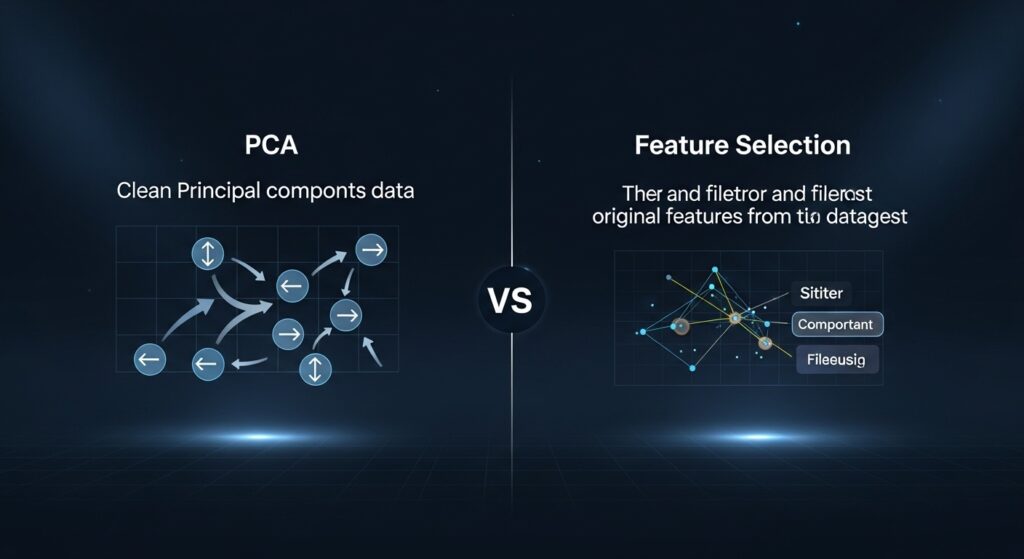
PCA vs Feature Selection
Feature selection removes features.
On the other hand, PCA transforms them.
This difference is important.
Feature selection keeps interpretability.
However, PCA boosts efficiency.
Thus, the goal decides the choice.
In AI systems, PCA is often preferred.
Because speed matters greatly.
Read more: AI Platform Training Made Simple: Everything You Need to Know
Advantages of Principal Component Analysis
PCA offers many benefits.
First, it reduces noise.
Second, it improves speed.
Third, it prevents overfitting.
Moreover, visualization becomes easier.
Two dimensions show patterns clearly.
As a result, understanding improves.
Additionally, PCA saves storage space.
Hence, scalability improves.
Limitations of PCA
Despite benefits, PCA has limits.
Interpretation becomes difficult.
Original features disappear.
Also, PCA assumes linear relationships.
Nonlinear data may suffer.
Therefore, careful use is required.
Still, PCA remains valuable.
Real-Life Use of PCA with AI
AI systems handle massive datasets.
Therefore, optimization is essential.
In computer vision, PCA reduces pixel data.
In finance, PCA analyzes risk patterns.
In healthcare, PCA detects hidden trends.
Thus, Principal Component Analysis with AI drives innovation.
PCA in Machine Learning Pipelines
Machine learning needs preparation.
Data preprocessing comes first.
PCA fits perfectly here.
After cleaning, PCA reduces dimensions.
Then, models train faster.
Consequently, accuracy improves.
Many frameworks support PCA.
Therefore, implementation is easy.
Read more: Machine Learning for Beginners: A Practical Guide (2026)
PCA and Deep Learning
Deep learning uses huge inputs.
Thus, dimensionality explodes.
PCA helps in early stages.
It reduces input size.
As a result, networks train faster.
Hence, PCA supports deep AI systems.
Common Applications of PCA
PCA appears across industries.
Marketing uses it for segmentation.
Finance applies it for portfolio analysis.
Healthcare uses PCA for diagnostics.
Cybersecurity applies it for anomaly detection.
Therefore, PCA remains universal.
PCA for Data Visualization
High-dimensional data is hard to view.
Humans understand only two dimensions.
PCA bridges this gap.
It compresses data visually.
Thus, clusters appear clearly.
As a result, storytelling improves.
Tools That Support PCA
Many tools implement PCA.
Python offers scikit-learn.
R includes built-in functions.
TensorFlow supports PCA.
Similarly, PyTorch allows it.
Hence, learning PCA is easy.
Read more: Best PCA Tools for Powerful Dimensionality Reduction in 2026
When You Should Use PCA
Use PCA for large datasets.
Apply it when features correlate.
Choose it when speed matters.
Avoid PCA when feature meaning matters most.
Thus, balance is essential.
Future of Principal Component Analysis with AI
AI continues to grow rapidly.
Data volumes keep expanding.
Therefore, PCA remains relevant.
Future AI systems need efficiency.
PCA delivers exactly that.
Hence, demand will increase.
Principal Component Analysis with AI will stay foundational.
Read more: PyTorch Basics to Advanced: A Complete Learning Guide 2026
Final Thoughts
Learning PCA is not difficult.
Instead, logic guides the process.
Once understood, confidence grows.
Principal Component Analysis simplifies complexity.
With AI, it becomes powerful.
Therefore, mastering PCA is valuable.
Start small.
Practice often.
Grow steadily.
FAQs: Principal Component Analysis
What is Principal Component Analysis in simple words?
Principal Component Analysis is a method to simplify data.
It reduces many variables into fewer important ones.
Why is PCA important in AI?
PCA improves data quality.
Better data leads to better AI performance.
Is Principal Component Analysis used in machine learning?
Yes, PCA is widely used.
It helps models train faster and perform better.
What is Principal Component Analysis with AI?
It means using PCA to prepare data for AI systems.
This improves speed, accuracy, and scalability.
Does PCA remove important information?
No, PCA keeps the most useful information.
Only noise and redundancy are reduced.
When should PCA not be used?
Avoid PCA when feature interpretation is critical.
Original meaning may be lost.
Is PCA hard to learn for beginners?
No, PCA is beginner friendly.
Simple practice makes it easy.
Call To action (CTA):
Want content that actually ranks on Google and brings traffic?
I create:
- SEO-optimized blog posts
- Keyword-focused content
- Easy-to-read articles with high engagement
Whether you run a blog, business, or AI website,
I can help you grow faster with smart content strategies.
Let’s work together and build content that performs.
📧 Email: craziya167@gmail.com
📱 WhatsApp: +92 371 4778412














Post Comment
You must be logged in to post a comment.