
AI Digital Ethics and Responsible AI: Everything You Need to Know
Introduction: Why AI Digital Ethics Matters More Than Ever
Artificial Intelligence is transforming the digital world at an unprecedented speed. However, as AI systems become more powerful, ethical concerns around AI are growing rapidly. AI digital ethics focuses on how artificial intelligence should be designed, deployed, and governed responsibly.
READ MORE: Artificial Intelligence New Technology: Latest AI News & Trends
Moreover, businesses, governments, and developers increasingly rely on AI for decision-making. As a result, ethical lapses can now impact privacy, fairness, security, and even human rights at scale. Therefore, understanding AI digital ethics is no longer optional—it is essential.
In this in-depth guide, you will learn what AI digital ethics is, why it matters, core ethical principles, real-world challenges, global regulations, and best practices for ethical AI development in 2026 and beyond.
READ MORE: Machine Learning Tools: The Ultimate SEO‑Optimized Guide for 2026
What Is AI Digital Ethics?
AI digital ethics refers to the moral principles and governance frameworks that guide the responsible use of artificial intelligence technologies.
Specifically, AI ethics addresses:
- Fairness and bias in AI algorithms
- Transparency and explainability
- Data privacy and protection
- Accountability and responsibility
- Human oversight and control
In other words, AI digital ethics ensures that AI systems benefit society without causing harm.
Why AI Digital Ethics Is Crucial in 2026
1. AI Is Embedded Everywhere
Today, AI powers:
- Search engines
- Recommendation systems
- Facial recognition
- Healthcare diagnostics
- Financial risk assessments
Therefore, any ethical flaw can affect millions instantly.
2. Increased Data Dependency
AI systems rely heavily on data. Consequently, unethical data collection or misuse can violate privacy rights and erode trust.
READ MORE: AI Social Impact in 2026: Opportunities, Risks, and the Future
3. Legal and Regulatory Pressure
Governments worldwide are introducing AI governance laws. As a result, ethical compliance is becoming a legal necessity, not just a moral choice.
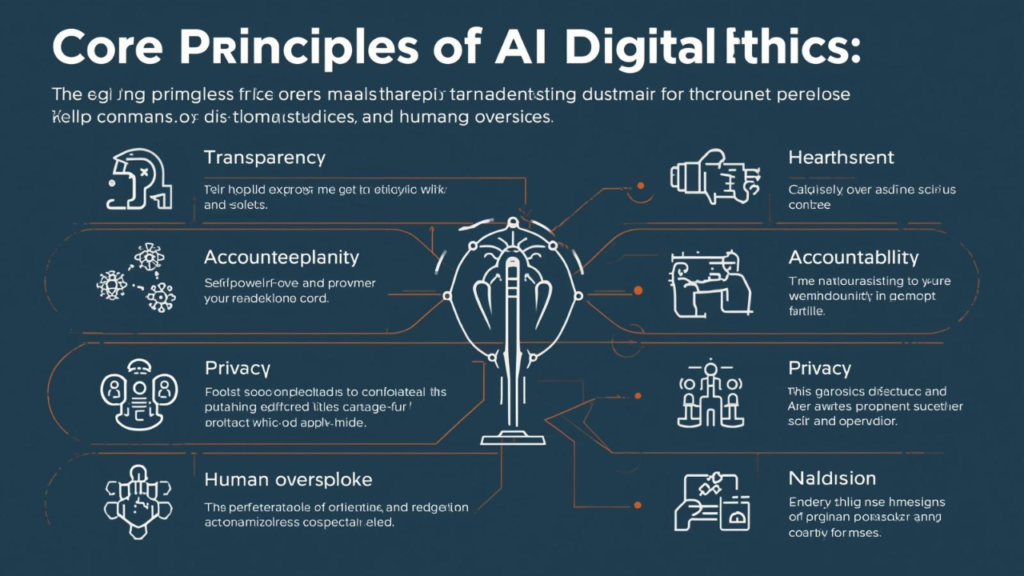
Core Principles of AI Digital Ethics
1. Transparency and Explainability
AI systems should be understandable. That is to say, users must know:
- How decisions are made
- What data is used
- Why outcomes occur
Without transparency, trust in AI collapses.
2. Fairness and Bias Mitigation
Bias in AI can lead to:
- Discrimination
- Unequal access
- Social harm
Therefore, ethical AI requires:
- Diverse datasets
- Bias testing
- Regular audits
3. Privacy and Data Protection
Ethical AI respects user privacy. As a result, organizations must:
- Minimize data collection
- Use anonymization
- Follow data protection laws
4. Accountability and Responsibility
Who is responsible when AI fails?
Ethical frameworks demand clear accountability, ensuring humans remain answerable for AI outcomes.
READ MORE: AI SEO Tutorial for Beginners: How to Rank Higher with AI
5. Human Oversight and Control
AI should support human decisions, not replace moral judgment. Hence, human-in-the-loop systems are critical.
Key Ethical Challenges in AI Systems
Algorithmic Bias
Bias arises when AI learns from flawed data. Consequently, marginalized groups may suffer unfair outcomes.
Lack of Explainability
Black-box AI systems make decisions without explanation. As a result, accountability becomes difficult.
Surveillance and Privacy Violations
AI surveillance tools can invade privacy. Therefore, ethical boundaries must be enforced.
Autonomous Decision-Making Risks
When AI acts independently, ethical risks increase. Thus, strict oversight is essential.
AI Digital Ethics in Different Industries
Healthcare
AI assists in diagnostics and treatment. However, biased algorithms can misdiagnose patients. Therefore, ethical validation is critical.

Finance
AI determines credit scores and fraud detection. Consequently, transparency and fairness are mandatory.
READ MORE: AI Data Ethics and Responsible AI: Everything You Need to Know
Education
AI personalizes learning. Nevertheless, data misuse can compromise student privacy.
Marketing and Advertising
AI targets users. Hence, ethical consent and transparency are required.
Global AI Ethics Regulations and Frameworks
EU AI Act
The EU AI Act categorizes AI risks and enforces compliance. As a result, ethical design is mandatory in Europe.
UNESCO AI Ethics Framework
UNESCO promotes human-centered AI. Therefore, social impact is prioritized.
READ MORE: Complete AI Tools Demo Review: Performance, Pricing & Real Results
OECD AI Principles
These principles emphasize:
- Human rights
- Transparency
- Accountability
AI Digital Ethics and E-E-A-T
Experience
Ethical AI is built on real-world testing and user feedback.
Expertise
AI ethics requires interdisciplinary expertise—from data science to philosophy.
Authoritativeness
Organizations that publish ethical AI policies build authority.
Trustworthiness
Transparency and accountability increase public trust.

Best Practices for Ethical AI Development
- Conduct ethical risk assessments
- Implement bias audits regularly
- Ensure explainable AI models
- Establish AI ethics committees
- Follow global compliance standards
- Maintain human oversight
- Educate teams on AI ethics
Role of AI Ethics Committees
AI ethics committees:
- Review AI projects
- Identify risks
- Ensure compliance
Therefore, they act as guardians of responsible innovation.
READ MORE: ChatGPT for Content Creation: A Simple Step-by-Step Guide
| AI Digital Ethics | AI Governance |
|---|---|
| Moral principles | Legal frameworks |
| Voluntary guidelines | Mandatory regulations |
| Focus on values | Focus on enforcement |
Together, they ensure responsible AI.
Future of AI Digital Ethics
Looking ahead:
- Ethical AI will become a competitive advantage
- Regulation will increase globally
- Public awareness will grow
- Ethical certifications may emerge
Therefore, early adoption of ethical AI is a strategic investment.
Common Myths About AI Digital Ethics
“Ethical AI Slows Innovation”
In reality, ethical AI builds long-term trust and sustainability.
“Ethics Is Only a Legal Issue”
Ethics goes beyond law—it reflects societal values.
Long FAQ Section (SEO + AEO Optimized)
What is AI digital ethics?
AI digital ethics is the study of moral principles guiding the responsible development and use of artificial intelligence technologies.
READ MORE: Model training: Powerful Guide to AI Growth in 2026
Why is AI digital ethics important?
AI digital ethics prevents bias, protects privacy, ensures fairness, and builds trust in AI systems.
What are the core principles of AI ethics?
Transparency, fairness, accountability, privacy, and human oversight are the core principles.
How does AI bias occur?
AI bias occurs due to biased data, flawed algorithms, or lack of diversity in training datasets.
What is the goal of AI digital ethics?
The goal is to make AI fair, safe, and responsible for everyone.
How does AI ethics protect user data?
AI ethics promotes secure data collection and better privacy protection.
Can AI ethics reduce algorithm bias?
Yes, ethical practices help reduce unfair and biased AI decisions.
Why do companies need ethical AI?
Ethical AI builds trust, improves reputation, and supports compliance.
Is AI digital ethics important for social media?
Yes, it helps platforms prevent misinformation and protect users.
What are ethical risks in AI systems?
Common risks include bias, privacy issues, and lack of transparency.
Can ethical AI improve business growth?
Yes, responsible AI can increase customer trust and long-term success.
Can AI be completely ethical?
While perfection is unlikely, ethical AI can be achieved through continuous monitoring and improvement.
What industries need AI ethics the most?
Healthcare, finance, education, law enforcement, and marketing rely heavily on ethical AI.
How can companies implement AI ethics?
By conducting audits, forming ethics committees, ensuring transparency, and following regulations.
Is AI digital ethics legally required?
In many regions, yes. Laws like the EU AI Act enforce ethical compliance.
What is explainable AI?
Explainable AI allows humans to understand how AI systems make decisions.
What is human-in-the-loop AI?
It ensures humans remain involved in AI decision-making processes.
How does AI ethics affect users?
It protects rights, ensures fairness, and increases trust.
READ MORE: Future of AI: Most Important AI Trends 2026
Will AI ethics evolve?
Yes. AI ethics will continuously adapt as technology advances.
Conclusion: Ethical AI Is the Future
In conclusion, AI digital ethics is the foundation of responsible artificial intelligence. As AI continues to shape society, ethical considerations must guide innovation.
Therefore, organizations that prioritize transparency, fairness, and accountability will not only comply with regulations—but also earn lasting trust and authority.
Ultimately, ethical AI is not a limitation; it is a long-term advantage.
CTA Conversion-Focused (Strong Action Words)
Want content that ranks, attracts traffic, and drives results?
I specialize in keyword research, on-page SEO, and SEO content writing that aligns with Google’s latest algorithms and E-E-A-T guidelines.
📧 Get started now: digitalminsa@gmail.com
Turn your website into a traffic-generating asset.











Post Comment
You must be logged in to post a comment.