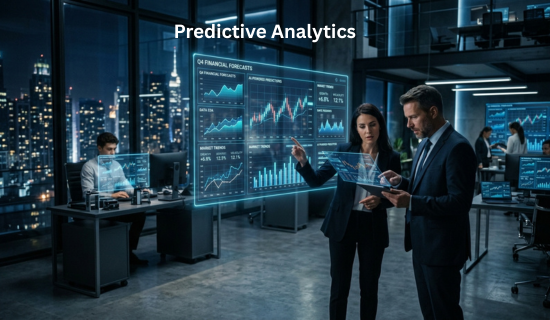
Predictive Analytics Made Simple for Modern Businesses
Predictive analytics is becoming more important every day.
Today, businesses want smarter decisions. They also want faster results. Because of this, many companies now depend on data instead of guesswork.
And honestly, that makes complete sense.
Why make random decisions when data can guide you?
That is where predictive analytics helps.
In simple words, predictive analytics studies old data. Then, it predicts what may happen in the future. As a result, businesses prepare earlier and avoid many problems.

For example, Netflix recommends movies you may enjoy. Similarly, YouTube suggests videos based on your interests. At the same time, online stores show products you may buy.
So, how do these platforms know your interests?
They use predictive analytics.
Therefore, predictive analytics is no longer just a business trend. Instead, it is becoming a necessity.
In this guide, you will learn everything in a simple way. Moreover, the explanations are easy to understand. Most importantly, even beginners can follow comfortably.
What Is Predictive Analytics?
Predictive analytics is a method that uses past data to predict future outcomes.
That is the simplest definition.
First, businesses collect information. Next, they study patterns carefully. After that, they make predictions about future behavior or trends.
Sounds smart, right?
For example, imagine a clothing store.
During winter, jacket sales increase every year. Because of this, the business prepares extra stock before winter arrives.
As a result, customers find products easily. Meanwhile, the business earns more profit.
That is predictive analytics in real life.
Instead of reacting late, businesses prepare early.
And that creates a huge advantage.
Read more: Supervised Learning in 2026: Best Methods, Models, and Uses
Why Does Predictive Analytics Matter Today?
The modern business world changes very fast.
Customer behavior changes quickly. Market trends also shift suddenly. Furthermore, competition continues growing every year.
Because of this, businesses need smarter planning.
Predictive analytics helps companies stay prepared.
For example:
- Stores predict customer demand
- Banks detect fraud early
- Hospitals identify health risks faster
- Marketing teams understand customer behavior better
Consequently, businesses reduce risks and improve performance.
At the same time, they save both time and money.
Clearly, predictive analytics offers real value.
How Does Predictive Analytics Work?
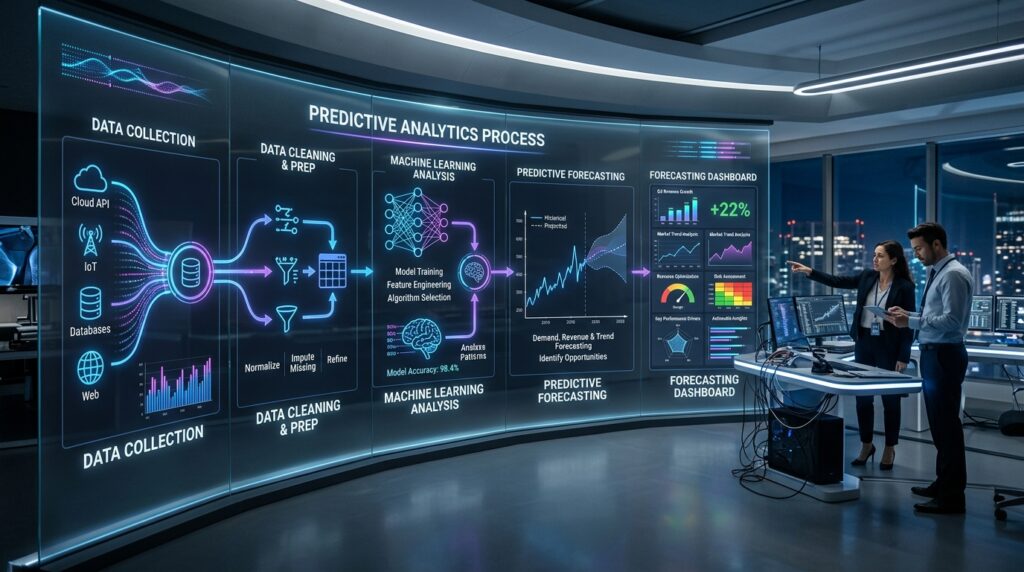
At first, predictive analytics sounds technical.
However, the process is actually simple.
Let’s understand it step by step.
1. Data Collection
First, businesses collect data.
This information may come from:
- Websites
- Mobile apps
- Customer purchases
- Surveys
- Social media
- Sales reports
Naturally, more useful data improves predictions.
However, quality matters more than quantity.
2. Data Cleaning
Raw data is usually messy.
Sometimes information is missing. In other cases, records are duplicated. Occasionally, data contains errors too.
Therefore, businesses clean the data carefully.
Why does this matter?
Because poor data creates poor predictions.
Simple.
Read more: Unsupervised Learning in AI: A Clear & Easy Guide
3. Pattern Analysis
Next, systems study patterns inside the data.
For example, customers may shop more during weekends. Similarly, online traffic may increase at night.
Over time, these patterns reveal useful behavior.
As a result, future trends become easier to predict.
4. Prediction Generation
After finding patterns, systems create forecasts.
For example, businesses may predict:
- Future sales
- Customer behavior
- Product demand
- Market trends
- Business risks
At this stage, companies start seeing valuable insights.
And honestly, this is where predictive analytics becomes exciting.
5. Decision Making
Finally, businesses use predictions to make smarter decisions.
For instance, they may increase inventory. Alternatively, they may launch marketing campaigns earlier.
In some cases, companies prepare for future risks before problems appear.
Consequently, decision-making becomes faster and more confident.
Why Is Predictive Data Analysis So Powerful?
Predictive data analysis helps businesses feel more confident.
And confidence matters a lot in business.
Imagine owning a restaurant.
Without predictions, food may get wasted. On busy days, customers may leave because items become unavailable.
Now imagine predicting demand earlier.
Suddenly, things improve.
Less waste. Better service. Happier customers.
That small change creates a big impact.
Because of this, predictive data analysis is becoming popular across many industries.
A Brief History of Predictive Analytics
Predictive analytics did not appear overnight.
Instead, it developed slowly over many years.
At first, businesses used basic statistics. Later, computers improved data analysis. Then, machine learning and AI changed everything completely.
Here is a simple timeline:
| Time Period | Major Development |
|---|---|
| 1950s | Basic forecasting methods |
| 1970s | Computer data analysis |
| 1990s | Large business databases |
| 2000s | Data mining tools |
| 2010s | Machine learning growth |
| 2020s | AI-powered predictions |
Today, predictive analytics is faster, smarter, and easier to use.
Even small businesses can benefit from it now.
Read more: AI Learning Path: Complete Roadmap from Beginner to Expert
What Are the Main Types of Predictive Analytics Models?

Different business problems require different models.
Therefore, companies use several predictive methods.
Let’s look at the most common ones.
Regression Models
Regression models predict numbers.
For example:
- Revenue forecasts
- Sales predictions
- Demand estimates
Imagine a bakery before Eid.
The owner studies previous sales data. Then, the business predicts how many cakes customers may buy this year.
As a result, preparation becomes easier.
Classification Models
Classification models organize information into categories.
For example:
- Spam or not spam
- Fraud or safe transaction
- Interested customer or not interested customer
Banks use these models daily.
Consequently, fraud detection becomes faster and more accurate.
Time-Series Models
These models study trends over time.
For example:
- Weather forecasts
- Monthly sales trends
- Website traffic patterns
Past behavior often helps predict future behavior.
Because of this, time-series models are very useful.
Machine Learning Models
Machine learning models improve automatically over time.
The more data they receive, the smarter they become.
Think about YouTube recommendations.
At first, suggested videos may feel random. However, after some time, recommendations improve significantly.
Why?
Because the system learns from your behavior continuously.
That is machine learning in action.
Read more: Machine Learning for Beginners: A Practical Guide (2026)
Read more: Machine Learning by Example: A Simple Guide for Beginners
Real-Life Examples of Predictive Analytics

Predictive analytics is everywhere today.
In fact, most people use it daily without realizing it.
Retail Industry
Stores use predictive analytics to forecast customer demand.
For example, supermarkets sell more cold drinks during summer. Therefore, they prepare extra inventory before temperatures rise.
As a result, shortages reduce.
Meanwhile, profits increase.
Banking Industry
Banks use predictive analytics to detect suspicious activity.
Have you ever received a security message from your bank?
Usually, that happens because systems noticed unusual behavior.
Consequently, fraud gets detected faster.
Healthcare Industry
Hospitals also use predictive analytics.
Doctors study patient information carefully. Then, they predict possible health risks earlier.
As a result, treatment becomes faster.
Sometimes, predictive analytics even helps save lives.
Marketing Industry
Marketing teams love predictive analytics.
Why?
Because it helps them understand customers better.
For example, online stores recommend products based on browsing history. Similarly, streaming platforms suggest content based on viewing behavior.
Consequently, customer engagement improves.
What Are the Benefits of Predictive Analytics?

Predictive analytics offers many advantages.
Because of this, businesses continue investing in it.
Better Decision-Making
Businesses make decisions using real information instead of assumptions.
As a result, mistakes decrease.
Meanwhile, planning improves.
Higher Efficiency
Companies use resources more effectively.
Therefore, waste decreases.
At the same time, productivity improves.
Lower Risks
Predictive systems identify warning signs early.
Consequently, businesses solve problems before situations become serious.
That saves both money and time.
Better Customer Experience
Customers receive better recommendations and services.
As a result, satisfaction increases.
Happy customers usually stay loyal longer.
Read more: The Truth About Artificial Intelligence Careers: Income, Skills & Demand
What Challenges Exist in Predictive Analytics?
Although predictive analytics is powerful, challenges still exist.
Therefore, businesses must use it carefully.
Poor Data Quality
Bad data creates inaccurate predictions.
Because of this, businesses must clean data properly.
Otherwise, results become unreliable.
Privacy Concerns
Customer privacy matters greatly.
Therefore, businesses must protect sensitive information carefully.
Trust is extremely important.
Lack of Skilled Experts
Some businesses struggle to find analytics professionals.
However, modern tools are becoming more beginner-friendly.
As a result, learning predictive analytics is becoming easier.
Predictive Analytics vs Traditional Analytics?
Many people confuse these terms.
However, they are different.
| Traditional Analytics | Predictive Analytics |
|---|---|
| Studies past results | Predicts future outcomes |
| Explains what happened | Forecasts what may happen |
| Reactive approach | Proactive approach |
That future-focused approach gives businesses a major advantage.
How Can Beginners Start With Predictive Analytics?
Starting predictive analytics feels difficult at first.
However, beginners can learn step by step.
Step 1: Define a Goal
First, decide what you want to predict.
For example:
- Sales trends
- Customer behavior
- Product demand
- Business risks
Clear goals improve focus.
Step 2: Collect Relevant Data
Next, gather useful information.
Avoid unnecessary data.
Focused data creates better results.
Read more: Best Data Mining Tools for Big Data & Analytics
Step 3: Use Beginner-Friendly Tools
Several tools help beginners start easily.
| Tool | Best For |
|---|---|
| Excel | Beginners |
| Python | Advanced analytics |
| R | Statistical analysis |
| Google AI Tools | Automation |
Start small.
Then, improve gradually.
Step 4: Test Predictions
Finally, test results carefully.
Never trust predictions blindly.
Small testing reduces risks significantly.
How Does AI Improve Predictive Analytics?
Artificial intelligence is making predictive analytics smarter.
Much smarter.
AI processes huge amounts of information quickly. Furthermore, it identifies patterns humans may miss.
For example, e-commerce websites update recommendations instantly.
As a result, customers receive better experiences.
And honestly, AI is only getting better.
Ethical Concerns in Predictive Analytics
Technology should always be used responsibly.
Because of this, ethics matter greatly in predictive analytics.
Businesses must protect customer privacy carefully. At the same time, they should avoid unfair predictions.
For example, biased systems may reject qualified job applicants unfairly.
Clearly, that creates problems.
Therefore, businesses must monitor systems regularly.
Responsible usage builds customer trust.
Read more: AI Data Ethics and Responsible AI: Everything You Need to Know
What Is the Future of Predictive Analytics?

The future looks extremely promising.
Predictive analytics will continue becoming faster and smarter.
AI integration will grow further. Meanwhile, automation will reduce manual work.
Eventually, real-time predictions may become standard.
Businesses adopting predictive analytics early will likely gain major advantages.
The shift has already started.
Tips to Improve Predictive Analytics Results
Want better predictions?
If yes, focus on these tips:
- Update data regularly
- Remove inaccurate information
- Test models frequently
- Use multiple data sources
- Monitor results continuously
Small improvements often create big results later.
Consistency matters more than perfection.
Read more: Data Augmentation Made Simple for Beginners
Frequently Asked Questions (FAQs)
What is predictive analytics in simple words?
Predictive analytics uses old data to predict future outcomes.
Is predictive analytics difficult to learn?
No.
Beginners can learn it gradually with practice and simple tools.
Can small businesses use predictive analytics?
Yes.
Even small businesses benefit from better predictions and smarter planning.
Does predictive analytics require coding?
Not always.
Many beginner-friendly tools offer no-code features.
Which industries use predictive analytics?
Read more: PCA in Python Made Easy: Basic and Easy Guide
Many industries use it, including:
- Retail
- Healthcare
- Banking
- Marketing
- E-commerce
Can predictive analytics make mistakes?
Yes.
Predictions depend heavily on data quality.
Poor data often creates inaccurate results.

Final Thoughts
Predictive analytics is changing modern business.
It helps companies make smarter decisions. Moreover, it improves efficiency and reduces risks.
Most importantly, predictive analytics helps businesses prepare for the future with confidence.
And the best part?
You do not need to become a data scientist to start learning.
Start small.
Practice consistently.
Learn gradually.
Over time, your understanding will grow naturally.
Call To Action
Need SEO content that ranks on Google and keeps readers engaged?
I create:
- SEO blog posts
- Keyword-focused articles
- Human-style content
- Easy-to-read blogs
- High-engagement website content
Let’s build content that performs.
📧 Email: craziya167@gmail.com
📱 WhatsApp: +92 371 4778412









Post Comment
You must be logged in to post a comment.