Clustering in AI and Machine Learning: Everything You Need to Know
Introduction Clustering in AI
Clustering in AI is one of the most powerful and widely used techniques in machine learning and data science. It enables systems to automatically identify patterns, similarities, and structures in data without any prior labeling. In an era where massive amounts of unstructured data are generated daily, clustering plays a crucial role in turning raw data into meaningful insights.
From customer segmentation and recommendation systems to image recognition and anomaly detection, clustering has become a backbone of modern Artificial Intelligence. Whether you are a beginner exploring machine learning or a professional aiming to refine your analytical skills, understanding clustering is essential in 2026 and beyond.
What Is Clustering in AI?
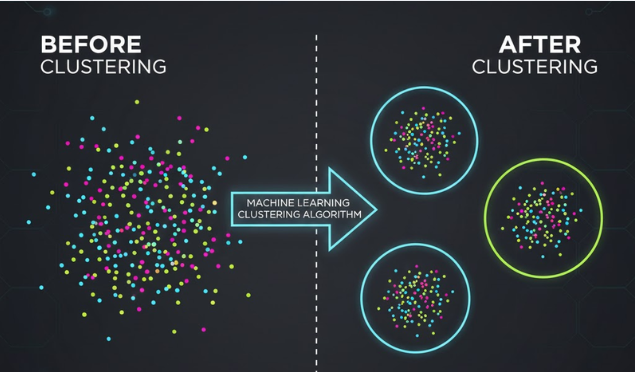
Clustering is an unsupervised learning technique that groups data points into clusters based on similarity. In this approach, each cluster contains data points that are more similar to each other than to those in other clusters.
Unlike supervised learning methods such as classification or regression, clustering does not rely on labeled data. Instead, it discovers hidden patterns and relationships directly from the data itself.
Read More: Understanding Ai Monitization: Make Money Artificial Intelligence
Simple Definition Clustering in AI
Clustering is the process of organizing similar data into meaningful groups without predefined labels.
Why Is Clustering Important?
Clustering in AI is important because it helps in:
- Understanding complex datasets
- Discovering hidden patterns
- Reducing data complexity
- Improving decision-making
- Enhancing business strategies
In real-world scenarios where labels are unavailable or expensive to obtain, clustering becomes an invaluable tool.
How Clustering Works?
The clustering process typically follows these steps:
- Data Collection – Gathering raw data from various sources
- Data Preprocessing – Cleaning, normalizing, and transforming data
- Feature Selection – Choosing relevant features
- Similarity Measurement – Calculating distances or similarities
- Cluster Formation – Grouping similar data points
- Evaluation – Measuring cluster quality
The success of clustering largely depends on choosing the right algorithm, distance metric, and preprocessing techniques.
Types of Clustering Techniques
1. Partition-Based Clustering in AI
Partition-based clustering divides data into a fixed number of clusters.
Key Characteristics:
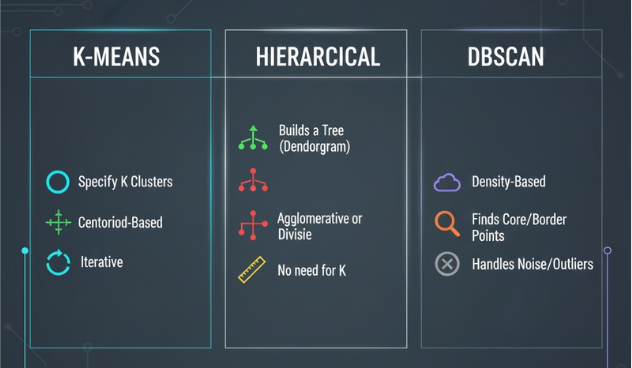
- Requires predefined number of clusters
- Efficient for large datasets
- Works best with spherical clusters
Example: K-Means Clustering
2. Hierarchical Clustering in AI
Hierarchical clustering builds clusters in a tree-like structure called a dendrogram.
Key Characteristics:
- No need to specify number of clusters beforehand
- Provides better interpretability
- Computationally expensive
3. Density-Based Clustering in AI
Density-based clustering groups data points based on dense regions.
Key Characteristics:
- Can find arbitrarily shaped clusters
- Identifies noise and outliers
- Works well with real-world data
Example: DBSCAN
4. Model-Based Clustering in AI
Model-based clustering assumes data is generated from a mixture of probability distributions.
Key Characteristics:
- Statistical and probabilistic approach
- Suitable for complex data
- Requires strong assumptions
Popular Clustering in AI Algorithms Explained
K-Means Clustering
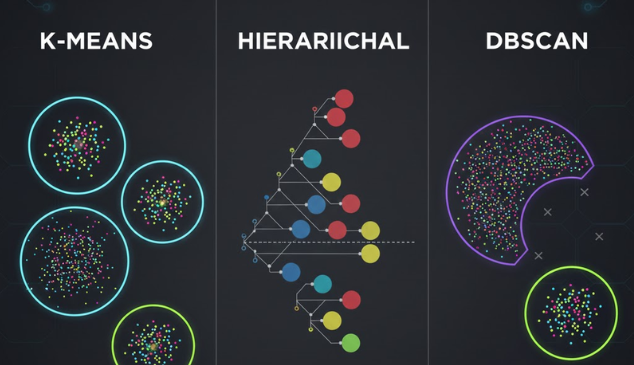
K-Means is the most popular clustering algorithm. It works by assigning data points to the nearest cluster centroid and updating centroids iteratively.
Advantages:
- Simple and fast
- Scales well to large datasets
Limitations:
- Sensitive to outliers
- Requires predefined K
Hierarchical Clustering
Hierarchical clustering forms clusters step-by-step.
Types:
- Agglomerative (bottom-up)
- Divisive (top-down)
It is ideal for exploratory analysis and small to medium datasets.
DBSCAN
DBSCAN stands for Density-Based Spatial Clustering of Applications with Noise.
Advantages:
- Handles noise effectively
- No need to specify number of clusters
Use Case: Fraud detection and anomaly detection
Mean Shift
Mean Shift identifies clusters by locating high-density regions.
Advantages:
- No predefined clusters
- Flexible cluster shapes
Real-World Applications of Clustering
Clustering is widely used across industries:
- Customer Segmentation – Grouping customers by behavior
- Market Research – Identifying trends and preferences
- Image Segmentation – Object and pattern recognition
- Document Clustering in AI – Organizing articles and news
- Fraud Detection – Identifying unusual transactions
- Healthcare – Patient risk grouping
- Recommendation Systems – Personalized suggestions
Advantages of Clustering in AI
- No labeled data required
- Discovers hidden patterns
- Reduces data complexity
- Improves personalization
- Supports exploratory analysis
Limitations of Clustering in AI
Despite its power, clustering has challenges:
- Choosing optimal number of clusters
- Sensitive to noisy and unscaled data
- Results vary by algorithm
- Interpretation may be subjective
Clustering in AI vs Classification
| Feature | Clustering in AI | Classification |
|---|---|---|
| Learning Type | Unsupervised | Supervised |
| Labeled Data | Not Required | Required |
| Objective | Pattern discovery | Prediction |
| Example | Customer groups | Spam detection |
Best Practices for Effective Clustering
- Normalize and scale data
- Remove outliers when necessary
- Choose appropriate distance metrics
- Validate clusters using evaluation metrics
- Visualize results for clarity
Evaluation Metrics for Clustering
- Silhouette Score
- Davies-Bouldin Index
- Calinski-Harabasz Index
These metrics help assess cluster quality and cohesion.
Future of Clustering in Artificial Intelligence
With the rise of big data, IoT, and AI-driven systems, clustering is evolving rapidly. Hybrid models combining clustering with deep learning are enabling more accurate and scalable solutions. In 2026, clustering remains a foundational skill for data scientists and AI engineers.
Frequently Asked Questions (FAQs)
What is clustering in simple words?
Clustering is a technique that groups similar data points together without using labels.
Is clustering part of machine learning?
Yes, clustering is a core concept in unsupervised machine learning.
Which clustering algorithm is best?
There is no single best algorithm. K-Means is popular, DBSCAN is great for noise, and hierarchical clustering is useful for exploration.
Does clustering require labeled data?
No, clustering works without labeled data.
What is the difference between K-Means and DBSCAN?
K-Means requires predefined clusters, while DBSCAN detects clusters based on density and handles noise.
Is clustering used in real businesses?
Yes, clustering is widely used in marketing, finance, healthcare, and e-commerce.
Can clustering be used with big data?
Yes, scalable clustering algorithms are designed for large datasets.
Is clustering difficult to learn?
Clustering is beginner-friendly conceptually but mastering it requires practice and experimentation.
Conclusion
Clustering is a fundamental machine learning technique that enables systems to uncover patterns and structure in data without supervision. It is essential for modern AI applications, from personalization and analytics to security and automation. By mastering clustering, you gain a powerful tool for understanding and leveraging data effectively in 2026.
Call to Action (CTA)
Elevate Your Website’s Growth with Professional SEO & Content Solutions
Are you finding it difficult to improve your Google rankings or reach the right audience? Moreover, do you want content that not only reads well but also delivers measurable outcomes? With hands-on experience in strategic keyword research, SEO-focused content creation, and effective on-page SEO, I help websites strengthen their online presence, increase traffic, and improve conversions.
Here’s how I can support your growth:
- Keyword Research: Identify profitable, low-competition keywords that align perfectly with your niche
- Content Writing: Develop compelling, SEO-optimized content that engages and converts readers
- On-Page SEO: Enhance titles, meta descriptions, headings, images, and internal links to improve search visibility
Whether you’re a blogger, business owner, or digital marketer, I offer result-driven SEO strategies tailored to your specific goals.
💡 Get Started Today!
Email me at zarirahc@gmail.com, and let’s explore how we can improve your website’s traffic, engagement, and overall performance.
Meanwhile, don’t delay—your competitors are already investing in SEO. Take the next step and move your website forward today!










Post Comment
You must be logged in to post a comment.